




 Start a live chat
 1-800-870-4800

The Provenance of a Molecule, Setria L-Glutathione
Setria® L-Glutathione is a short phrase that carries a great deal. Read word by word, it names a producer, a form of the molecule, a method of making it and a way of carrying it into a capsule, for a molecule that appears again and again in the study of longevity.
In brief
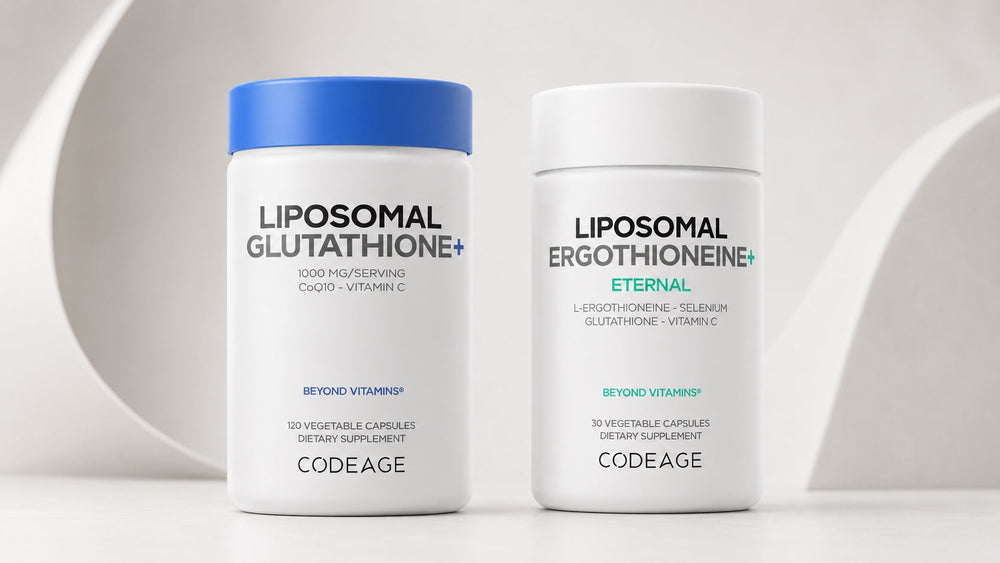
Setria® is the registered trade name for reduced L-glutathione produced by Kyowa Hakko Bio in Japan through a proprietary fermentation process. On the Codeage label, the name identifies the specific ingredient inside and the source it comes from.
Each part of the phrase has a meaning. The L describes the natural mirror image form of the molecule, glutathione names a tripeptide of glutamate, cysteine and glycine, and the phospholipid complex on the Codeage bottle describes how the ingredient is carried in the formula. Glutathione sits within Cellular Longevity, the third pillar of The Longevity Code.
I
A Registered Name on a Molecule
Glutathione is glutathione. Wherever it is found, in a cell, a food or a capsule, the molecule has the same three building blocks joined in the same order. It is often described as the tripeptide at the center of cellular redox biology, and that description belongs to the molecule, not to any one maker of it. The same chemistry is why glutathione is a recurring subject in longevity research, where scientists study how cells maintain their internal balance across a lifetime.
An ingredient is something more particular. It is a quantity of that molecule made by a specific manufacturer, through a specific process, to a specific standard. The registered name in front of the word glutathione is how a label tells a reader which ingredient sits inside the capsule.
Setria® is the trade name for the L-glutathione made by Kyowa Hakko Bio, a Japanese company whose own name carries the word hakkō, meaning fermentation. A registered ingredient brings two things with it: consistency, since every batch carrying the name comes from the same producer, and a research record, because studies conducted on that named material can be traced back to it.
On the Codeage label, Setria® makes both threads visible. Nothing about the molecule changes. What the name adds is how much a reader can know about the material in their hand.
Reading the bottle
Six Terms on the Label
What each word on the front of the bottle and the Supplement Facts panel describes.
| Term | What it describes | Where it appears |
|---|---|---|
| Setria® | The registered trade name for L-glutathione produced by Kyowa Hakko Bio, identifying a single named source | Front of the bottle and the Supplement Facts panel |
| L- | The mirror image form of the molecule that living cells build with, as opposed to the D form | Before the word glutathione, on both |
| Glutathione | A tripeptide of glutamate, cysteine and glycine, with a sulfur bearing thiol group supplied by cysteine | Product name and ingredient line |
| Reduced form | The state written GSH, in which the thiol group is free; Setria® is supplied in this form | Implied by the ingredient name |
| Phospholipid complex | Codeage's Helix liposomal format, with phospholipids from non-GMO sunflower lecithin, including phosphatidylcholine | Front of the bottle and Other Ingredients |
| 500 mg | The amount of Setria® L-Glutathione in one serving, with 30 servings per container | Supplement Facts panel |

One molecule, one named source, one way of carrying it.
II
The L, the Thiol and an Unusual Bond
The single letter before the hyphen is easy to overlook. Molecules such as cysteine and glutamate have a central carbon arranged so that two mirror image versions can exist, much as a left and a right hand share a structure without being interchangeable. Living systems build almost exclusively with the L versions. Glycine, the third component, has no left or right form at all, so the prefix describes the molecule as a whole.
Glutathione also differs from most peptides in how it is joined. Its glutamate attaches to cysteine through the side chain rather than the usual backbone position, a linkage chemists call a gamma bond. Researchers have long noted that this arrangement makes glutathione less familiar to the enzymes that ordinarily break peptides apart, one reason it holds a distinct place in cellular chemistry.
The working part of the molecule is the thiol, a sulfur atom paired with hydrogen. Two glutathione molecules can give up that hydrogen and join at the sulfur, which is how reduced GSH becomes oxidized GSSG, and cells then convert it back. The cycle between reduced and oxidized glutathione is one of the most studied balances in redox biology. A label that specifies the reduced form is naming the side of that cycle the ingredient begins on.
The body also makes its own glutathione inside cells from the same three amino acids, in two enzyme steps. That is why glutathione is so often discussed alongside its precursors and the amino acid pool, and why the finished tripeptide named on this label is a different thing from its building blocks.
III
Made by Fermentation, a Long Lineage
Setria® is produced through a proprietary fermentation process. In fermentation, microorganisms grown under controlled conditions produce a specific compound as part of their own metabolism, and the compound is then separated and purified. Kyowa Hakko has worked with fermentation for decades to produce amino acids and related compounds, and its glutathione comes from that same discipline.
There is a quiet symmetry in this. The first recorded observation of the substance later named glutathione was made in 1888, in an extract of yeast, a fermenting organism. The full account, from that observation to the naming of the molecule in 1921 and the confirmation of its structure in 1935, is set out in the long history of glutathione research.
Fermentation also explains a detail the label leaves unsaid. Because the process yields glutathione directly, in its reduced L form, the ingredient arrives as the finished tripeptide rather than as a mixture of parts. The capsule around it is plant based methylcellulose.

Provenance
One Molecule, a Named Source
Glutathione has one structure wherever it comes from. The registration mark tells a reader where this particular glutathione was made, and how.
IV
The Research Attached to the Name
The trial most often cited for Setria® was a six month randomized, double blind, placebo controlled study led by researchers at Penn State College of Medicine, published as Richie et al., 2015, in the European Journal of Nutrition. Fifty four healthy adults took 250 mg or 1,000 mg of glutathione daily, or a placebo, followed by a one month washout.
The investigators measured glutathione in several body compartments, including blood and red blood cells, at set intervals across the six months and again after the washout. The study was supported by the ingredient's manufacturer, which the authors disclosed.
This is what a named ingredient makes possible. Because the material in the trial was identified, a reader can see which ingredient was studied, at what amounts and for how long. In longevity science, where one molecule can reach readers under many names, that traceability is what lets a study and a label be read side by side. Studies referenced were conducted independently and did not involve any specific Codeage product.
A molecule has one structure.
An ingredient has a history.
The label says which one you hold.
From source to capsule
Four Stages Behind the Name
Each stage leaves a mark on the words printed on the bottle.
-

Origin
Fermentation in Japan
Microorganisms grown under controlled conditions produce glutathione as part of their own metabolism.
-

Form
Reduced L-glutathione
The finished tripeptide, in the L form and the reduced state, with its thiol group free.
-

Identity
The Setria® name
A registered trade name that links the ingredient to its producer and to the research on that material.
-

Delivery
Phospholipid complex
Codeage's Helix liposomal format, with phospholipids from non-GMO sunflower lecithin.
V
The Phospholipid Complex, the Last Words
The front of the bottle describes the formula as a phospholipid complex, and the Other Ingredients line explains what that means. The glutathione is carried in Codeage's Helix liposomal format, with phospholipids from non-GMO sunflower lecithin, including phosphatidylcholine. The format is described on the Helix Liposomal Delivery page.
Phosphatidylcholine is among the most common phospholipids in human cell membranes, the double layered boundary around every cell. In a liposomal format, phospholipids arrange themselves around the active ingredient in a structure that resembles those membranes.
The practical side of that pairing, from what the format is to how it fits into a daily routine, is covered in what liposomal glutathione is and how it is taken.
VI
Where This Fits in Longevity
Glutathione sits within Cellular Longevity, the third pillar of The Longevity Code, the dimension concerned with the chemistry that sustains each cell across time. A pillar names a location in a framework. It describes a category within longevity, not an outcome for any reader.
Read together, the words form a complete sentence. A named producer, a defined form of the molecule, a fermentation origin, a measured amount and a phospholipid carrier. Knowing exactly which glutathione a formula contains is where any serious conversation about it begins.

Three amino acids
One Sulfur Atom, Many Words
Glutamate, cysteine and glycine. Everything else on the label describes where they came from and how they reach the capsule.
The vocabulary
Six Terms Behind the Name
The words that appear in almost every account of glutathione as an ingredient.
-
Tripeptide
A short chain of three amino acids. Glutathione joins glutamate, cysteine and glycine.
-
Thiol
A sulfur atom bonded to hydrogen, supplied by cysteine. The chemically active part of glutathione.
-
GSH
Reduced glutathione, with its thiol group free. The form in which Setria® is supplied.
-
GSSG
Oxidized glutathione, two molecules joined at their sulfur atoms. Cells convert it back to GSH.
-
Fermentation
Production of a compound by microorganisms grown under controlled conditions, followed by purification.
-
Phosphatidylcholine
A phospholipid common in human cell membranes, supplied in this formula from non-GMO sunflower lecithin.
Questions
What People Ask Most
What is Setria L-Glutathione?
Who makes Setria?
What does the L in L-Glutathione mean?
Is Setria the reduced form of glutathione?
What does phospholipid complex mean on the label?
Has Setria been studied in people?
How much Setria is in Codeage Liposomal Glutathione?
Where does glutathione fit in The Longevity Code?
One molecule, a name with a history.
A label worth reading slowly.
Setria L-Glutathione, read word by word, from the producer and the L form to fermentation and the phospholipid complex. A small chapter in the larger story of longevity.
Setria® L-Glutathione in Codeage's Helix liposomal format.
Shop Liposomal GlutathioneContinue reading
Further Reading from the Codeage Library
-
Education
Compartments of the Cell, Where Glutathione Lives
-
Education
A Deep Dive into Liposomal Delivery
-
Education
A Modern Perspective on N-Acetyl L-Cysteine
-
The framework
The Longevity Code
Codeage, The Longevity Code
A System Built for the Long View
The Longevity Code is a four pillar daily system, every formula mapped to a specific dimension of how the body sustains itself across time.
Join The Code: The Longevity CodeThis article is educational and is not intended to diagnose, treat, cure, or prevent any disease. Studies referenced were conducted independently and did not involve any specific Codeage product. These statements have not been evaluated by the Food and Drug Administration.


