




 Start a live chat
 1-800-870-4800
Compartments of the cell —
where glutathione lives
at the subcellular level.
Inside the cell, glutathione is not distributed uniformly. The cytosol holds the largest pool. The mitochondria hold their own. The nucleus and the endoplasmic reticulum each maintain distinct pools with their own dynamics, their own concentrations, and their own internal chemistry. The subcellular map of the molecule, drawn from the literature.
I
The cell is not one room —
and glutathione is not in just one of them.
The interior of a cell is not a single open space. It is partitioned into distinct compartments, each enclosed by its own membrane, each maintaining its own internal chemistry, its own pH, its own population of molecules. The cytosol — the watery solution that fills most of the cell's volume — is one of these compartments. The mitochondria, the nucleus, the endoplasmic reticulum, and the various other organelles are the others. Each compartment is, in chemical terms, almost a small ecosystem of its own.
Glutathione is present in essentially every one of these compartments — but the concentration varies, and the dynamics differ. The cytosol holds the largest fraction of the cell's total glutathione pool, often described in the literature as approximately 85 to 90 percent of cellular glutathione by mass. The remaining 10 to 15 percent is distributed across the other compartments, with the mitochondria typically holding the next largest share. The nucleus, the endoplasmic reticulum, and the various smaller organelles each carry their own pools, often at concentrations that reflect their distinct cellular roles.
The compartmentalisation is not passive. The cell actively moves glutathione between compartments through dedicated transporter proteins. The synthesis machinery — the GCL and GSS enzymes — operates principally in the cytosol, meaning the cytosol is both the largest pool and the production centre. Glutathione is then imported into the other compartments by transporter systems specific to each organelle membrane. The mitochondrial membrane, the nuclear envelope, the endoplasmic reticulum membrane — each has its own dedicated glutathione transport biology.
85 to 90 percent in the cytosol.
The rest distributed elsewhere.
The cell maintains its glutathione
as a series of connected but distinct pools.
The compartments mapped
Four cellular compartments —
each carrying its own glutathione pool.
The cards below describe the four principal cellular compartments in which glutathione has been characterised. Each maintains its own concentration, its own dynamics, and its own internal chemistry — connected to the others by dedicated transporter systems.
I
Cytosol
The principal pool · ~85–90% of cellular total
The watery solution that fills most of the cell's volume. The cytosol holds the largest fraction of the cell's total glutathione — typically described in the literature as approximately 85 to 90 percent. The synthesis machinery operates here; the molecule is then distributed to other compartments by dedicated transporters.
II
Mitochondria
Energy-generating organelle · own pool
The site of cellular energy generation. The mitochondrial matrix carries a glutathione pool described in the literature as comparable to the cytosolic concentration on a per-volume basis. Mitochondria do not synthesise their own glutathione — the molecule is imported across the inner mitochondrial membrane.
III
Nucleus
Genetic material compartment · distinct pool
The largest cellular organelle, containing the genetic material. The nucleus maintains its own glutathione pool with its own dynamics, varying across the cell cycle. The nuclear pool has been increasingly characterised over the past two decades as experimental tools for nuclear-specific chemistry have progressed.
IV
Endoplasmic Reticulum
Oxidising compartment · the exception
The principal site of protein folding — and the cellular compartment with an oxidising rather than reducing internal environment. The ER glutathione pool is present at a more oxidised GSH:GSSG ratio than the cytosol, participating in the chemistry of disulphide bond formation in newly synthesised proteins.
II
The mitochondrial pool —
the most studied of the non-cytosolic compartments.
Mitochondrial glutathione is one of the most extensively studied subcellular pools in modern cellular biology. The reason is straightforward: mitochondria are the principal site of cellular energy generation, and the chemistry of ATP production produces a high local volume of reactive intermediates. The glutathione pool in the mitochondrial matrix is closely involved in handling that local chemistry. The mitochondrial pool is, in this sense, geographically positioned where some of the busiest redox chemistry in the cell takes place.
The mitochondrial glutathione concentration is often described in the literature as comparable to or slightly higher than the cytosolic concentration on a per-volume basis — although the mitochondrial matrix is a smaller compartment, so the absolute amount is smaller. The mitochondrion does not synthesise its own glutathione; the molecule is produced in the cytosol and imported across the mitochondrial inner membrane by a dedicated transport system. The biology of this transport has been characterised in considerable detail across decades of mitochondrial research.
The dynamics of the mitochondrial pool are partly independent of the cytosolic pool. Although the two compartments are connected by transport, they can maintain different glutathione concentrations, different GSH:GSSG ratios, and different redox states. The mitochondrial pool can become depleted while the cytosolic pool remains intact, or vice versa. This compartmental independence is one of the features that makes the subcellular map of glutathione particularly interesting to cellular biology research — and one of the reasons the literature regards the mitochondrial pool as worth examining in its own right rather than as a simple extension of the cytosolic pool.
The cytosol reducing.
The endoplasmic reticulum oxidising.
The mitochondrial pool largely its own.
One cell, many chemistries.
The compartments do not blur into each other.
The subcellular distribution in numbers
Three observations the literature returns to —
about how the cell partitions its glutathione.
~85–90%
The fraction of cellular glutathione held in the cytosol — the principal pool by mass
The cytosol holds approximately 85 to 90 percent of the cell's total glutathione by mass. The remaining 10 to 15 percent is distributed across the other compartments — mitochondria, nucleus, endoplasmic reticulum, and smaller organelles — each with its own dynamics and its own dedicated transport biology.
Imported
The mitochondrial glutathione pool is supplied from the cytosol — not synthesised in situ
Mitochondria do not synthesise their own glutathione. The molecule is produced in the cytosol by GCL and GSS, and imported into the mitochondrial matrix across the inner membrane by a dedicated transport system. The biology of mitochondrial glutathione import has been characterised in considerable detail across decades of cellular research.
Oxidising
The endoplasmic reticulum maintains an oxidising environment — the exception among cellular compartments
Unlike the cytosol, mitochondria, and nucleus — which all maintain reducing internal environments — the endoplasmic reticulum is the principal cellular compartment with an oxidising chemistry. The ER glutathione pool sits at a different GSH:GSSG ratio than the rest of the cell, participating in the chemistry of protein folding and disulphide bond formation.
III
The nuclear and ER pools —
smaller, distinct, increasingly studied.
The nucleus — the cell's largest organelle, containing the genetic material — carries its own glutathione pool. The literature on nuclear glutathione has developed more slowly than the literature on the mitochondrial pool, partly because the experimental tools for studying nuclear-specific chemistry took longer to develop. But the field has, across the past two decades, increasingly characterised the nuclear glutathione environment as a distinct compartment with its own dynamics. The nuclear pool is involved in chemistry connected to the maintenance of the cellular genetic material, and the glutathione content of the nucleus varies across the cell cycle in ways the field continues to examine.
The endoplasmic reticulum (ER) is, in many ways, the most chemically distinctive of the cellular compartments. Unlike the cytosol, mitochondria, and nucleus — which maintain reducing internal environments — the ER is the principal cellular compartment with an oxidising internal environment. This is because the ER is the site of protein folding, and the formation of correct disulphide bonds in proteins requires an oxidising chemistry. The glutathione pool in the ER is therefore present at a different GSH:GSSG ratio than the cytosolic pool — substantially more oxidised than the cytosol's ratio described in the redox cycle article. The ER glutathione pool participates in the chemistry of disulphide bond formation in newly synthesised proteins.
Other organelles maintain smaller glutathione pools that have been examined to varying degrees in the literature: the peroxisomes, the lysosomes, the Golgi apparatus. Each has its own membrane, its own internal chemistry, its own dynamics. The full subcellular map of glutathione across the cellular architecture is one of the longer-running characterisation projects in cellular biology — and continues to develop as imaging and analytical methods continue to develop. The molecule that the tissue distribution article describes across organs is also distributed, at finer resolution, across the compartments of every individual cell within those organs. Studies referenced were conducted independently and did not involve any specific Codeage product. The literature on subcellular glutathione continues to develop; the picture described reflects the current understanding rather than a closed account.
Codeage · Cellular Longevity · Pillar 03
The Codeage glutathione line —
formats from the Pillar 03 architecture.
Formulations from the Codeage glutathione line — the tripeptide the body produces, in formats designed for daily use.
Liposomal Glutathione
The flagship of the Codeage glutathione architecture. Reduced L-glutathione (GSH) supplied in a phospholipid vesicle format — the Helix Liposomal delivery system used in select Codeage formulations. The Pillar 03 anchor of the cellular redox conversation.
View Product →Liposomal Glutathione+
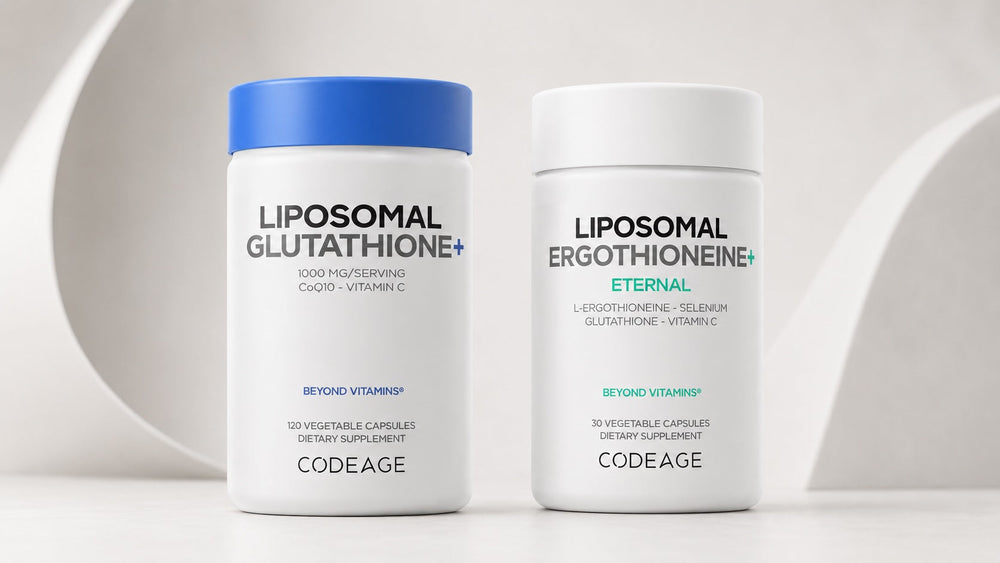
A combination liposomal format pairing reduced L-glutathione with vitamin C and CoQ10 — three molecules the literature has explored in the context of cellular redox biology, brought together in the Helix Liposomal vesicle architecture.
View Product →Liposomal Glutathione 1000 mg
Reduced L-glutathione presented in a concentrated capsule format with phospholipid encapsulation. For those who prefer the daily-capsule approach to the Pillar 03 cellular redox category.
View Product →Article A5 · Previously in this cluster
How the Body Makes Glutathione — Biosynthesis From Amino Acid to Tripeptide
Codeage · The Longevity Code
The cell's internal architecture —
part of the cellular long view.
Pillar 03 of the Longevity Code addresses the molecules the cell uses to sustain itself across time — and the compartments through which it organises them.
Explore The Longevity Code →


