







 Start a live chat
 1-800-870-4800
Sulforaphane —
the compound broccoli
makes when broken.
Sulforaphane is not quite present in a head of broccoli. It is made at the moment the plant is broken — when an enzyme meets a stored precursor and a sulphur-bearing molecule appears. Among the compounds of the plant world, few have been studied as closely. Its connection to glutathione is not direct, but it is one of the more interesting threads in the cell's chemistry.
I
A compound that is not there until the leaf is broken —
and the question of what the field has been watching.
Sulforaphane is a strange kind of molecule to introduce, because in an intact broccoli plant it does not really exist yet. What the plant stores is a precursor — a stable molecule called glucoraphanin — kept separate from the enzyme that can act on it. Only when the plant tissue is damaged, by chewing, chopping, or crushing, do the two meet. The enzyme, myrosinase, acts on glucoraphanin, and the reaction produces sulforaphane: a small, sulphur-bearing compound that was not present a moment before. It is, in effect, a molecule the plant assembles on demand, as a response to injury.
That sulphur is what connects sulforaphane to the family of molecules this series has been mapping. Sulforaphane belongs to a chemical class called the isothiocyanates, and like the other compounds in the cluster — from the cysteine of NAC and glutathione to the dietary ergothioneine — it carries a sulphur atom at the heart of its chemistry. The pungent, slightly sharp taste of raw broccoli, rocket, and mustard greens is the taste of this sulphur chemistry at work, a relative of the same notes that the article on the thiol group traced through onions and eggs.
The phrase "the field has been watching" is the honest way to describe sulforaphane's standing. It is one of the most-studied plant compounds in the published literature, the subject of a large and still-growing body of research across many laboratories. Much of that interest centres on a particular cellular signalling system that sulforaphane has been studied in connection with — and it is through that system, rather than through any direct chemical role, that the threads to glutathione run. It is a connection worth describing carefully, which the sections that follow try to do.
The intact plant holds only a precursor.
The broken plant makes the molecule.
Sulforaphane is assembled on demand —
a response to the breaking of the leaf.
The four parts of the story
Four elements of the sulforaphane story —
the precursor, the enzyme, the compound, and the pathway it is studied with.
Sulforaphane's story runs from a stored precursor to a signalling system the literature has examined. The cards below sketch the four parts that matter most.
I
Glucoraphanin
The precursor · stored in the plant
A stable sulphur-containing compound stored in cruciferous plants, kept physically separate from the enzyme that can act on it. On its own it is inert; it is the dormant form that the plant carries until its tissue is damaged.
II
Myrosinase
The enzyme · released on damage
The plant enzyme that acts on glucoraphanin, kept apart from it in intact tissue and brought into contact only when the plant is chewed, chopped, or crushed. The meeting of the two is what sets the reaction in motion.
III
Sulforaphane
The isothiocyanate · the product
The sulphur-bearing compound produced when myrosinase acts on glucoraphanin. A member of the isothiocyanate family, it is the molecule responsible for much of the sharp character of raw cruciferous greens, and the focus of the research interest.
IV
The Nrf2 pathway
The system it is studied with
A cellular signalling pathway that the literature associates with how cells regulate a set of antioxidant-related and stress-response genes. Sulforaphane has been widely studied in connection with this pathway — the route by which the threads to glutathione are usually drawn.
II
From glucoraphanin to sulforaphane —
the kitchen chemistry of a sulphur molecule.
The making of sulforaphane is, in the first instance, a piece of food chemistry. Cruciferous vegetables — broccoli, cauliflower, cabbage, kale, rocket, mustard greens, and their relatives — store glucoraphanin in their tissues and keep myrosinase walled off separately. This separation is a feature, not an accident: the plant holds the two apart so that the reactive product is generated only when needed, at the moment of damage. When you bite into raw broccoli or chop it on a board, you are running the reaction yourself, and the sharp note you taste is the sulforaphane and its chemical relatives being formed.
This is why the details of preparation matter so much to the chemistry, and why the topic recurs throughout the literature. Myrosinase is sensitive to heat, and heavy cooking can deactivate it before it has the chance to act — which is part of why broccoli sprouts, eaten raw, are so often discussed: they are a particularly concentrated source of the glucoraphanin precursor. The biochemistry of how much sulforaphane forms, and under what conditions, is an active and well-populated area of food science, studied independently of any product or supplement.
As a molecule, sulforaphane is small and, like the others in this cluster, defined by its sulphur. Its membership in the isothiocyanate family places it in a different chemical category from the thiols of cysteine and glutathione or the dithiol of alpha-lipoic acid, but the common thread of sulphur runs through them all. Where it differs most from the rest of the cluster is in how it relates to glutathione: not as a building block, not as a member of the redox network, but through a cellular signalling system — which is the subject of the final section.
Most of the cluster connects to glutathione
through chemistry — a bond, an electron, a thiol.
Sulforaphane connects through something else:
a signalling system the field has studied.
The compound in numbers
Three observations on sulforaphane —
the precursor, the reaction, and the research.
Two parts
A stored precursor and a separate enzyme, kept apart until the plant tissue is broken
Cruciferous plants store glucoraphanin and myrosinase in separate compartments. Only when the tissue is damaged do the two meet and the reaction produces sulforaphane — a molecule generated on demand rather than held ready-made.
Sprouts
Young broccoli sprouts are widely discussed as a concentrated source of the glucoraphanin precursor
Because heat can deactivate myrosinase, raw and lightly prepared cruciferous foods are most often discussed in the food-chemistry literature, with broccoli sprouts noted as a particularly concentrated source of the precursor molecule.
One pathway
The Nrf2 signalling system, the route through which sulforaphane's research links to glutathione are drawn
Much of the research interest centres on the Nrf2 pathway, a signalling system the literature associates with the regulation of antioxidant-related and stress-response genes. It is the indirect route by which sulforaphane is connected, in the literature, to glutathione chemistry.
III
Sulforaphane in the neighbourhood —
a connection drawn through a signalling system.
The way sulforaphane relates to glutathione is different from everything else in this cluster, and the difference is worth stating plainly. NAC supplies a building block. Vitamin C and alpha-lipoic acid sit in the redox network and cycle alongside glutathione. Ergothioneine occupies its own sulphur niche. Sulforaphane does none of these things directly. Its connection to glutathione, as drawn in the literature, runs through a cellular signalling pathway — the Nrf2 system — which researchers associate with the way cells regulate the expression of a family of antioxidant-related and stress-response genes, some of them involved in glutathione metabolism.
It is important to describe this at the right level of caution. The relationship is one the research literature has studied extensively; sulforaphane is among the most examined molecules in connection with the Nrf2 pathway. But describing a molecule as being studied in relation to a signalling system is a statement about a body of research, not a statement about what the molecule does in any given person. The science here is genuinely interesting, and genuinely active, and also genuinely unsettled in many of its particulars — which is the most accurate way to leave it. The cell's regulation of its own glutathione-related machinery is a deep topic, and sulforaphane is one of the molecules that has drawn the field's attention to it.
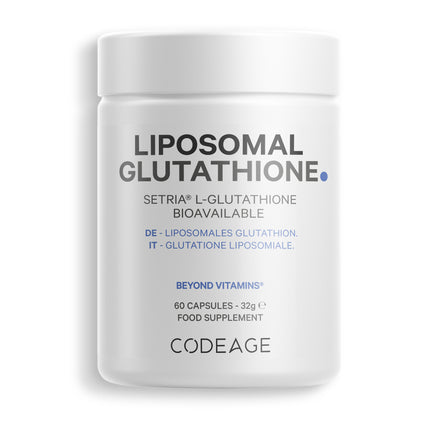
Within the Codeage catalogue, the cellular pillar is built around glutathione itself rather than around the plant compounds studied alongside it. The Liposomal Glutathione formulation supplies the tripeptide directly; the Liposomal Vitamin C+ Platinum and Liposomal Glutathione+ bring several network molecules together in single liposomal formats. These sit within the Pillar 03 architecture of the Longevity Code, where the molecules of cellular chemistry are housed as one coherent daily system. The literature on sulforaphane and the Nrf2 pathway continues to develop; the picture described here reflects the current understanding rather than a closed account.
Codeage · Cellular Longevity · Pillar 03
The tripeptide at the centre —
formats from the Pillar 03 line.
Glutathione and the molecules it is studied alongside — formulations from the Codeage glutathione line, in formats designed for daily use.
Liposomal Glutathione
The cornerstone of the Codeage glutathione line. Reduced L-glutathione (GSH) supplied in a phospholipid vesicle format — the Helix Liposomal format used in select Codeage formulations. The Pillar 03 anchor of the cellular redox conversation.
View Product →Liposomal Vitamin C+ Platinum
A liposomal vitamin C formulation built with L-glutathione, NAC, resveratrol, and rutin — molecules the literature has examined in connection with cellular redox biology, assembled in a single Helix Liposomal preparation.
View Product →Liposomal Glutathione+
A combination liposomal format pairing reduced L-glutathione with vitamin C and CoQ10 — three molecules the literature has explored in the context of cellular redox biology, brought together in the Helix Liposomal vesicle architecture.
View Product →Previously in this series
Alpha-Lipoic Acid and Glutathione — A Sulphur Molecule on Both Sides of the Membrane
Codeage · The Longevity Code
The molecules of the cell —
within one daily system.
The cellular pillar of the Longevity Code houses the tripeptide and the molecules studied alongside it as parts of one coherent daily architecture.
Explore The Longevity Code →This article is provided for educational and informational purposes only and has been reviewed against FDA and FTC guidelines to ensure it does not make any health, disease, or treatment claim. Any research or studies referenced were conducted independently and did not involve Codeage products; no Codeage product has been used in any study or to establish, prove, or imply any benefit. These statements have not been evaluated by the Food and Drug Administration. Codeage products are not intended to diagnose, treat, cure, or prevent any disease.


