




 Start a live chat
 1-800-870-4800
Alpha-lipoic acid and glutathione —
a sulphur molecule on
both sides of the membrane.
Most of the molecules in the cell's redox network keep to one territory: vitamin C in the watery interior, vitamin E in the fatty membranes. Alpha-lipoic acid keeps to neither — and to both. A small sulphur-bearing molecule, made in part by the body and obtained in part from food, that moves between the two worlds of the cell.
I
A molecule that keeps to both worlds —
the watery interior and the fatty membrane alike.
The cell is divided into two kinds of space. There is the watery interior — the cytosol and the fluid contents of its compartments — and there are the membranes, the thin sheets of fat that wrap the cell and its organelles. Most molecules belong to one or the other. A molecule that dissolves in water tends to stay in the watery spaces; a molecule that dissolves in fat tends to stay in the membranes. The cell's redox network reflects this division: vitamin C, the water-soluble member this series met in the article on its conversation with glutathione, works in the watery rooms; vitamin E, the fat-soluble member, works in the membranes.
Alpha-lipoic acid is unusual because it does not respect the division. It is small, and it carries both a fat-friendly part and a water-friendly part on the same molecule, which means it dissolves in both kinds of space. Where most members of the network are specialists of one territory, alpha-lipoic acid moves between the watery interior and the fatty membrane, at home in either. It is this quality that led researchers, at one point, to describe it informally as a universal sort of molecule — a description that is a characterisation of its solubility rather than a settled claim about anything it does.
That dual citizenship is the most distinctive thing about the molecule, and it is the reason to read it beside glutathione. Glutathione is firmly a molecule of the watery interior. Alpha-lipoic acid can meet it there, in the cytosol, but it can also travel where glutathione cannot, into the membranes. In the geography of the cell this series has been drawing, alpha-lipoic acid is the molecule that crosses between neighbourhoods — a sulphur-bearing compound that belongs, in a sense, to the whole map rather than to one district of it.
Vitamin C keeps to the water.
Vitamin E keeps to the fat.
Alpha-lipoic acid keeps to both —
the molecule that crosses
between the two worlds of the cell.
Four features of the molecule
Four things that set alpha-lipoic acid apart —
its two sulphurs, its two forms, its two origins, and its reach.
Alpha-lipoic acid sits apart from the other members of the redox network in several ways at once. The cards below sketch the four the literature returns to most often.
I
A dithiol
The structure · two sulphur atoms
Alpha-lipoic acid carries two sulphur atoms, joined in a small five-membered ring. In its reduced form that ring opens into two free thiol groups. Where cysteine carries one sulphur, lipoic acid carries a pair — placing it firmly within the cell's sulphur chemistry.
II
Two forms
Lipoic acid and dihydrolipoic acid
Like the other members of the network, it cycles between an oxidised form (lipoic acid, with the ring closed) and a reduced form (dihydrolipoic acid, or DHLA, with the ring open and two free thiols). The cycling between the two is what places it in the redox conversation.
III
Made and eaten
The origin · part synthesis, part diet
Unlike vitamin C, which is entirely dietary, the body synthesises small amounts of lipoic acid for its own use, where it serves as a cofactor for certain mitochondrial enzymes. Smaller amounts also arrive through the diet. A molecule both made within and obtained without.
IV
Both-soluble
The reach · water and fat alike
Its defining trait: solubility in both water and fat, which lets it move through both the watery interior and the fatty membranes of the cell. Most network members keep to one territory; lipoic acid moves between them, the rare amphipathic member of the set.
II
The dithiol and the cofactor —
a molecule with a day job and a place in the network.
Alpha-lipoic acid has, in a sense, two identities in the cell. The first is its day job. The small amount the body makes is put to work as a cofactor — a helper molecule bound to certain enzymes deep in the mitochondria, where it takes part in the reactions that draw energy from food. In this role it is not free-floating at all; it is attached, by a firm chemical bond, to the large enzyme complexes it serves. This is the molecule's original and best-established part in biology, worked out over decades of study of mitochondrial metabolism.
The second identity is the one that places it beside glutathione. When lipoic acid is free rather than enzyme-bound, it can cycle between its two forms — the closed-ring oxidised form and the open-ring reduced form, dihydrolipoic acid, with its two free thiols. That cycling is the language of the redox network, the same two-form principle that governs the GSH and GSSG cycle of glutathione. In the network literature, the reduced form has been described as a participant in the regeneration of other members — the kind of electron handoff this series traced between vitamin C and glutathione. Lipoic acid, by this account, is one more node in the connected set.
What makes it a particularly interesting node is its reach. Because it moves through both the watery and the fatty parts of the cell, it has been studied as a molecule that can take part in the redox conversation in places where the strictly water-soluble members cannot follow. It is, in the network's geography, something like a courier that crosses district lines — present in the cytosol where glutathione works, and present too in the membranes where the fat-soluble members keep. The two sulphur atoms it carries connect it to the wider sulphur family this series has mapped, from the cysteine of NAC and glutathione onward.
A cofactor bound deep in the mitochondria.
A free molecule cycling in the network.
Alpha-lipoic acid is both at once —
two identities in one small ring.
The molecule in numbers
Three observations on alpha-lipoic acid —
two sulphurs, two forms, and two worlds.
Two sulphurs
The pair of sulphur atoms that distinguish lipoic acid from the single-sulphur cysteine
Alpha-lipoic acid carries two sulphur atoms in a small ring; in its reduced form, dihydrolipoic acid, the ring opens into two free thiol groups. The paired sulphurs place it within the cell's sulphur chemistry, beside the single-sulphur cysteine of the glutathione building blocks.
Two forms
Lipoic acid and dihydrolipoic acid — the oxidised and reduced members of its redox couple
The molecule cycles between a closed-ring oxidised form and an open-ring reduced form. This cycling is what places it inside the redox network, the same two-form principle that governs glutathione's GSH and GSSG and vitamin C's ascorbate and dehydroascorbate.
Two worlds
Solubility in both water and fat — the trait that sets it apart from the other network members
Where vitamin C keeps to the watery interior and vitamin E to the fatty membranes, alpha-lipoic acid dissolves in both. That dual solubility lets it move between the two kinds of cellular space, the rare amphipathic member of the redox set.
III
Alpha-lipoic acid in the neighbourhood —
the molecule that links the districts of the map.
If this series has been drawing a map of the cell's sulphur and redox chemistry — districts of molecules, each with its own territory and dynamics — then alpha-lipoic acid is the one that does not sit still inside a single district. It belongs to the sulphur family by its two sulphur atoms. It belongs to the redox network by its cycling between two forms. And it belongs to both the watery and the fatty regions by its unusual solubility. It is less a resident of one neighbourhood than a connector between several, and that is precisely the quality the research literature has found interesting about it.
The wider picture is, once again, one of a connected set rather than a collection of soloists. The literature describes the redox network as an interlocking system — water-soluble members and fat-soluble members, single-sulphur molecules and double-sulphur ones, dietary compounds and endogenous ones, all linked through the shared currency of electrons. Alpha-lipoic acid occupies an unusual seat in that system precisely because it bridges categories that most molecules keep separate. It is a molecule the field continues to study, with new work appearing regularly on its biology, its distribution, and its relationships to the other members of the network.
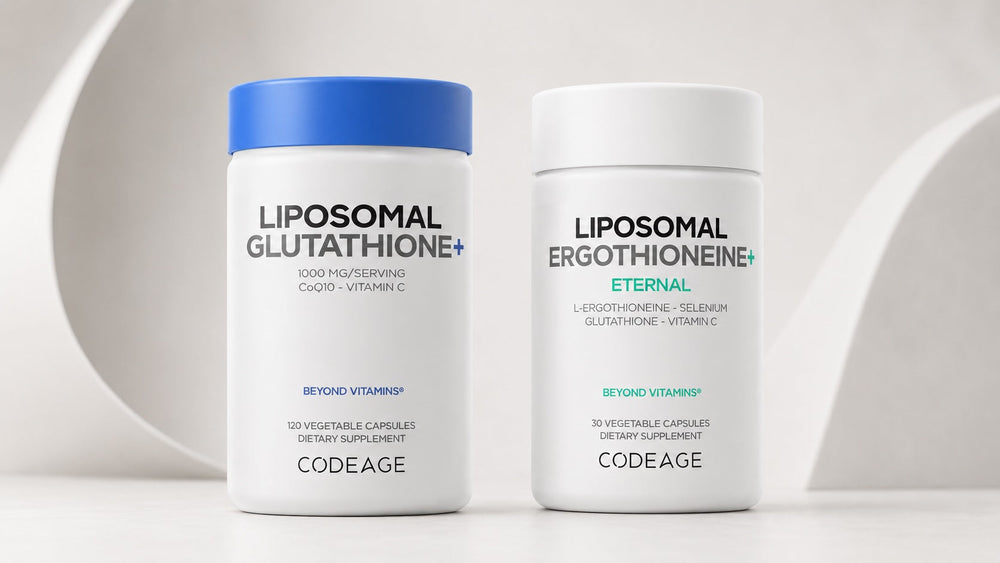
The contemporary Codeage catalogue is built around the network's anchor rather than around lipoic acid itself. The Liposomal Glutathione hero supplies the tripeptide at the centre of the watery side of the network; the Liposomal Vitamin C+ Platinum and Liposomal Glutathione+ bring several network molecules together in single liposomal formats. These sit within the Pillar 03 architecture of the Longevity Code, where the molecules of cellular chemistry are housed as one coherent daily system. The literature on alpha-lipoic acid and the redox network continues to develop; the picture described here reflects the current understanding rather than a closed account.
Codeage · Cellular Longevity · Pillar 03
The anchor of the network —
formats from the Pillar 03 line.
Glutathione and the molecules it cycles with — formulations from the Codeage glutathione line, in formats designed for daily use.
Liposomal Glutathione
The cornerstone of the Codeage glutathione line. Reduced L-glutathione (GSH) supplied in a phospholipid vesicle format — the Helix Liposomal format used in select Codeage formulations. The Pillar 03 anchor of the cellular redox conversation.
View Product →Liposomal Vitamin C+ Platinum
A liposomal vitamin C formulation built with L-glutathione, NAC, resveratrol, and rutin — molecules the literature has examined in connection with cellular redox biology, assembled in a single Helix Liposomal preparation.
View Product →Liposomal Glutathione+
A combination liposomal format pairing reduced L-glutathione with vitamin C and CoQ10 — three molecules the literature has explored in the context of cellular redox biology, brought together in the Helix Liposomal vesicle architecture.
View Product →Previously in this series
Glutathione and Vitamin C — A Cellular Conversation Between Two Molecules
Codeage · The Longevity Code
A connected network —
within one daily system.
The cellular pillar of the Longevity Code houses the tripeptide and the molecules it cycles with as parts of one coherent daily architecture.
Explore The Longevity Code →This article is provided for educational and informational purposes only and has been reviewed against FDA and FTC guidelines to ensure it does not make any health, disease, or treatment claim. Any research or studies referenced were conducted independently and did not involve Codeage products; no Codeage product has been used in any study or to establish, prove, or imply any benefit. These statements have not been evaluated by the Food and Drug Administration. Codeage products are not intended to diagnose, treat, cure, or prevent any disease.


