











 Démarrer un chat en direct
 1-800-870-4800
Deux vitamines.
Des décennies de recherche.
Ce que la science a étudié sur l'acide ascorbique (vitamine C) et le cholécalciférol (vitamine D3) — et pourquoi les chercheurs en longévité continuent d'étudier les deux.
La question fondamentale
La longévité se construit en couches. La première couche est souvent la plus négligée.
Parmi les micronutriments les plus étudiés en biologie moderne, l'acide ascorbique (vitamine C) et le cholécalciférol (vitamine D3) occupent une place distinctive. Tous deux sont fondamentaux. Tous deux ont une portée étendue à travers la physiologie humaine. Et tous deux ont accumulé des décennies d'investigation évaluée par des pairs sur leur relation avec le vieillissement en bonne santé. Cet article explore ce que les chercheurs ont étudié — et ce que cette recherche signifie dans un cadre de longévité.
Acide ascorbique
Un micronutriment hydrosoluble que le corps humain ne peut synthétiser par lui-même. L'acide ascorbique fonctionne à la fois comme nutriment et comme cofacteur dans de multiples réactions enzymatiques étudiées en biologie cellulaire et moléculaire. Dans la recherche sur la longévité, les scientifiques ont examiné son rôle dans les processus oxydatifs, la biosynthèse du collagène et la fonction des cellules immunitaires.
Cholécalciférol
Un sécostéroïde liposoluble synthétisé dans la peau lors de l'exposition aux UV-B et également obtenu par l'alimentation et la supplémentation. Le cholécalciférol (vitamine D3) se convertit en sa forme active, le calcitriol, qui fonctionne comme un composé de type hormonal. Les chercheurs ont étudié sa présence dans pratiquement tous les tissus et systèmes d'organes avec des sites récepteurs identifiés (VDR) dans tout le corps.
Axe de recherche — Acide ascorbique
Ce que les chercheurs ont étudié sur la vitamine C et le vieillissement
Ce qui suit représente des domaines de recherche scientifique active. Ces résultats sont des observations de recherche publiées et ne constituent pas des allégations médicales.
La vitamine C en tant qu'antioxydant dans les environnements cellulaires
Les chercheurs ont longtemps étudié le rôle de l'acide ascorbique comme capteur de radicaux libres. Une revue de référence publiée dans Free Radical Biology and Medicine a examiné comment l'acide ascorbique neutralise les espèces réactives de l'oxygène (ROS) dans les environnements cellulaires aqueux. Le stress oxydatif — l'accumulation de ROS au fil du temps — est une caractéristique biologique bien documentée associée au vieillissement cellulaire. Les scientifiques ont étudié si le maintien d'un statut adéquat en acide ascorbique était corrélé aux marqueurs de dommage oxydatif dans les populations vieillissantes.
↗ Frei et al., Free Radical Biology & Medicine (1989)Le rôle de l'acide ascorbique dans les réactions d'hydroxylation
La vitamine C sert de cofacteur essentiel pour la prolyl hydroxylase et la lysyl hydroxylase — les enzymes responsables de la stabilisation de la structure en triple hélice du collagène. Cette relation biochimique a été largement étudiée en dermatologie et dans la recherche sur les tissus conjonctifs. Un article dans Nutriments (2017) a synthétisé des preuves indiquant que la disponibilité de l'acide ascorbique semble influencer directement le rythme et la qualité de la biosynthèse du collagène, reliant le statut en vitamine C à l'intégrité structurelle des tissus au fil des décennies de vieillissement.
↗ Pullar et al., Nutrients (2017)Investigations sur l'acide ascorbique et la longueur des télomères
Le raccourcissement des télomères est un biomarqueur central du vieillissement biologique. Une étude publiée dans American Journal of Clinical Nutrition a examiné les concentrations plasmatiques de vitamine C ainsi que la longueur des télomères leucocytaires dans une large cohorte d'adultes. Les chercheurs ont observé que les individus présentant des concentrations plasmatiques d'acide ascorbique plus élevées avaient tendance à avoir des télomères plus longs, en tenant compte des variables liées au mode de vie. Les auteurs ont noté que cette relation méritait une étude mécanistique plus approfondie pour comprendre les voies potentielles.
↗ Richards et al., AJCN (2007)Statut en vitamine C et biomarqueurs du vieillissement cardiovasculaire
L'étude EPIC-Norfolk, l'une des plus grandes études de cohorte prospectives d'Europe, a examiné les niveaux plasmatiques de vitamine C en relation avec les résultats cardiovasculaires chez 20 000 participants sur dix ans. Les chercheurs ont documenté une association graduée et inverse entre les niveaux plasmatiques d'acide ascorbique et le risque de mortalité cardiovasculaire — une association qui persistait après ajustement pour les facteurs de confusion connus. Les chercheurs ont souligné la nécessité de comprendre si cela reflète une causalité ou s'il s'agit d'un biomarqueur de l'adéquation nutritionnelle globale.
↗ Khaw et al., The Lancet (2001)Cinétique d'absorption : acide ascorbique standard versus liposomal
La biodisponibilité de la vitamine C orale a fait l'objet de recherches pharmacocinétiques. Une étude dans Nutrition and Metabolic Insights a comparé les concentrations plasmatiques de vitamine C suite à une supplémentation standard en acide ascorbique par rapport à l'encapsulation liposomale. Les formulations liposomales ont démontré des valeurs de Cmax plasmatique (concentration maximale) et d'aire sous la courbe (ASC) significativement plus élevées, suggérant que l'encapsulation phospholipidique pourrait modifier de manière significative la dynamique d'absorption — une constatation pertinente pour toute personne évaluant un complément de vitamine C ou des formulations de vitamine C liposomale.
↗ Davis et al., Nutrition & Metabolic Insights (2016)Cholécalciférol · Vitamine D3 · Vit D3
L'étendue de l'investigation sur la vitamine D3 en science de la longévité
Récepteur de la vitamine D (VDR) et expression génomique
Le récepteur de la vitamine D (VDR) a été identifié dans plus de 36 types de tissus. Une revue complète dans Nature Reviews Endocrinology a décrit comment la forme active de la vitamine D (1,25-dihydroxyvitamine D3 / calcitriol) se lie au VDR et module l'expression de gènes impliqués dans la régulation du cycle cellulaire, la fonction immunitaire et les voies inflammatoires. L'ampleur de cette portée génomique a fait de la vitamine D3 un composé central dans la recherche sur la biologie du vieillissement.
↗ Holick, Nature Reviews Endocrinology (2010)Cholécalciférol, absorption du calcium et vieillissement squelettique
Parmi les domaines les plus établis de la recherche sur la vitamine D figure son rôle dans le métabolisme du calcium et du phosphore. La vitamine D3 est nécessaire pour l'absorption intestinale du calcium — un mécanisme étudié dans des essais cliniques examinant la densité minérale osseuse dans les populations vieillissantes. Une méta-analyse dans JAMA Internal Medicine portant sur plus de 135 000 participants a révélé que la supplémentation en vitamine D avec un apport adéquat en calcium était associée à une incidence réduite de fractures chez les personnes âgées institutionnalisées. Les auteurs ont noté que les résultats variaient selon le statut nutritionnel de base.
↗ Bischoff-Ferrari et al., JAMA Internal Medicine (2009)Recherche sur la vitamine D3 et l'immunosénescence
L'immunosénescence — le déclin progressif de la fonction immunitaire avec l'âge — est un facteur reconnu des défis de santé liés au vieillissement. Les chercheurs ont identifié des VDR sur presque tous les types de cellules immunitaires, y compris les lymphocytes T, les lymphocytes B et les macrophages. Une revue de 2020 dans Nutriments a examiné systématiquement les preuves selon lesquelles la vitamine D3 joue un rôle régulateur dans les réponses immunitaires innée et adaptative, avec une pertinence particulière pour les populations vieillissantes qui présentent souvent des niveaux circulants de 25(OH)D plus faibles.
↗ Charoenngam & Holick, Nutrients (2020)Vitamine D, longueur des télomères et marqueurs du vieillissement cellulaire
De multiples études épidémiologiques ont examiné la relation entre les niveaux sériques de vitamine D et la longueur des télomères. Une étude publiée dans PLoS ONE analysant les données de l'enquête nationale américaine sur la santé et la nutrition (NHANES) a révélé que des concentrations sériques plus élevées de 25(OH)D étaient associées à une longueur de télomère leucocytaire plus longue, selon un schéma dose-réponse. L'association se maintenait à travers plusieurs groupes d'âge. Les chercheurs ont proposé que les propriétés anti-inflammatoires et antioxydantes de la vitamine D pourraient expliquer en partie les associations observées avec les marqueurs du vieillissement cellulaire.
↗ Richards et al., PLoS ONE (2007)Statut en vitamine D dans les populations à longue vie
La recherche examinant les « zones bleues » et les cohortes de centenaires a systématiquement noté que les individus dans les populations à longue vie présentent souvent des niveaux d'activité extérieure et d'exposition au soleil sains tout au long de leur vie — des comportements associés au maintien du statut en vitamine D. Bien que la causalité reste complexe à établir, un article de 2012 dans le Journal of Gerontology examinant la biologie des centenaires a répertorié un statut adéquat en vitamine D3 parmi les micronutriments les plus systématiquement observés à des niveaux sains chez les individus atteignant un âge avancé. Le paysage des compléments pour les formulations de complément de vitamine D et de complément de vitamine D3 continue d'être façonné par ce corpus de recherche.
↗ Passeri et al., Journal of Gerontology (2008)Cholécalciférol (D3) versus ergocalciférol (D2) — ce que les chercheurs ont constaté
Toutes les vitamines D ne sont pas équivalentes. Les chercheurs comparant le cholécalciférol (D3, d'origine animale et UV) et l'ergocalciférol (D2, d'origine végétale) ont constaté des différences pharmacocinétiques significatives. Un essai randomisé en double aveugle publié dans l' American Journal of Clinical Nutrition a révélé que le cholécalciférol était environ 87 % plus puissant pour augmenter et maintenir les concentrations sériques de 25(OH)D. Cette distinction est devenue centrale dans les choix de formulation de la catégorie des compléments de vitamine D3 et vit D3.
↗ Heaney et al., AJCN (2011)L'intersection
Pourquoi les chercheurs étudient la C et la D ensemble
Les deux vitamines opèrent sur des territoires biologiques se chevauchant — et les chercheurs en longévité ont noté des rôles complémentaires dans plusieurs voies partagées.
C
D3
Régulation immunitaire — un domaine de recherche partagé
L'acide ascorbique et le cholécalciférol ont tous deux été étudiés indépendamment dans le contexte de la fonction des cellules immunitaires. Une revue de 2020 dans Frontiers in Immunology a exploré leurs rôles complémentaires potentiels, notant que la vitamine C se concentre dans les cellules immunitaires à des niveaux 10 à 100 fois supérieurs à ceux du plasma, tandis que la vitamine D3 agit sur les VDR exprimés sur ces mêmes types de cellules. Les chercheurs ont appelé à davantage d'investigation sur les stratégies nutritionnelles combinées et la résilience immunitaire dans les populations vieillissantes.
↗ Gombart et al., Nutrients (2020)Deux voies antioxydantes — phase aqueuse et phase lipidique
La biologie humaine opère dans deux environnements chimiques distincts : aqueux (à base d'eau, où la vitamine C fonctionne) et lipidique (à base de graisse, où la vitamine D3 est transportée). La recherche a examiné comment ces deux micronutriments pourraient aborder les processus oxydatifs dans leurs environnements respectifs. Une revue dans Antioxydants (2021) a discuté de l'importance potentielle d'assurer un statut adéquat des composés antioxydants hydrosolubles et liposolubles pour une défense oxydative complète chez les adultes vieillissants.
↗ Carr & Rowe, Antioxidants (2020)Forme et Diffusion
Comment le format de délivrance façonne la recherche
La recherche n'étudie pas seulement ce qu'un composé fait — elle étudie comment le corps le reçoit.
Vitamine C liposomale
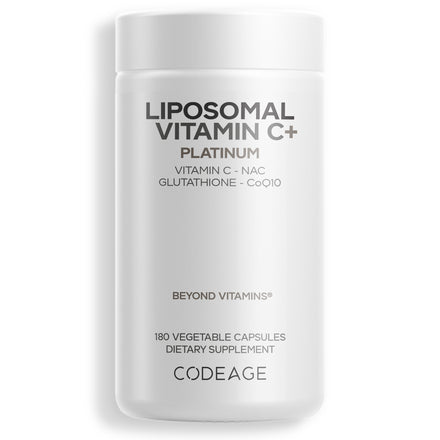
L'encapsulation liposomale utilise des bicouches phospholipidiques — le même matériau structurel que les membranes cellulaires — pour protéger l'acide ascorbique durant le transit gastro-intestinal. Des études pharmacocinétiques ont démontré que la délivrance liposomale contourne le transporteur intestinal saturable (SVCT) qui limite les capsules de vitamine C standard et l'absorption d'acide ascorbique à doses plus élevées. Pour toute personne recherchant des formulations optimales de complément de vitamine C, le mécanisme de délivrance liposomale représente l'une des innovations les plus étudiées dans le domaine.
Complément de vitamine C · Vitamine C liposomale · Acide ascorbiqueVitamine D3 + K2 — La relation de cofacteur
Les chercheurs étudiant le cholécalciférol l'examinent de plus en plus conjointement avec la vitamine K2 (MK-7). Le raisonnement : la vitamine D3 favorise l'absorption du calcium, tandis que la vitamine K2 aide à diriger le calcium vers le tissu osseux et à l'éloigner des parois artérielles. Une étude publiée dans Thrombosis and Haemostasis (2015) a révélé que la supplémentation combinée D3 + K2 montrait des effets supérieurs sur les marqueurs de rigidité vasculaire par rapport à chaque nutriment pris isolément. La combinaison D3/K2 est devenue un axe central de la recherche sur les compléments de vitamine D3 et l'investigation du vieillissement osseux-cardiovasculaire.
Vitamine D3 · Cholécalciférol · Vit D3Le Code de la Longévité
Où se situent la C et la D3 dans le système
Dans le cadre du Code de la Longévité, l'acide ascorbique et le cholécalciférol sont tous deux classés sous le Pilier 01 — la couche de base dont tout le reste dépend.
La couche de base n'est pas le pilier le plus passionnant. C'est le plus important. Le NAD+ et le resvératrol opèrent à un niveau cellulaire que les chercheurs continuent de cartographier. La vitamine C et la D3 opèrent à un niveau que les chercheurs cartographient depuis plus d'un siècle — et les preuves continuent de s'approfondir.
Continuer la Lecture
Approfondir la science
Qu'est-ce qui fait une excellente vitamine C ?
Une exploration approfondie des principes de formulation derrière une supplémentation premium en acide ascorbique — et ce qui distingue une formule standard de capsules de vitamine C d'une formule de précision.
Vitamine D3 : le guide complet du cholécalciférol
Tout ce que les chercheurs et formulateurs doivent comprendre sur le cholécalciférol — de la synthèse à la supplémentation, jusqu'à la science évolutive de la vit D3 et du vieillissement.
Le Code de la Longévité · Codeage
La longévité n'est pas une catégorie.
C'est une décision de conception.
Des décennies de recherche sur la vitamine C et la vitamine D3 convergent vers un seul constat : la performance à long terme du corps est façonnée par des apports réalisés de manière constante — sur des années, pas des semaines. Le Code de la Longévité a été construit sur cette prémisse.
Découvrir le Longevity Code →Contenu éducatif uniquement. Les études citées sont des recherches indépendantes et ne représentent pas une approbation par les chercheurs d'un produit spécifique. Consultez un professionnel de santé qualifié avant de commencer tout programme de supplémentation, en particulier si vous êtes enceinte, si vous allaitez, si vous prenez des médicaments ou si vous souffrez d'une condition médicale.


