






 Start a live chat
 1-800-870-4800

Why Healthspan Matters as Much as Lifespan
Longevity science once asked a single question: how long do people live? Today it asks a second one alongside it, how many of those years are lived in good health, and the distance between the two answers has become one of the most closely watched numbers in the field.
In brief
Lifespan is the number of years a person lives. Healthspan is the portion of those years spent in good health.
The two can move apart. An analysis of World Health Organization data across 183 countries found that the gap between life expectancy and health-adjusted life expectancy widened between 2000 and 2019, which is why longevity research now studies healthspan as a measure in its own right.
I
Two Ways to Count a Life
For most of modern history, the simplest measure of a population's health was how long its people lived. Life expectancy is easy to define and relatively easy to count, and across the twentieth century it rose in much of the world. It became the headline figure in public health, and it still is.
Lifespan, however, says nothing about the character of the years it counts. A year spent walking, working and thinking clearly carries the same weight as a year spent with serious illness or limited independence. Researchers began to want a second number, one that counted only the years lived well.
That second number is healthspan. A widely used definition describes it as the period of life spent in good health, without the chronic diseases and disabilities of aging. Public health agencies track a related figure: the World Health Organization publishes healthy life expectancy, the average number of years a person at a given age can expect to live in full health.
Seen together, the two numbers tell a fuller story than either does alone. The rest of this article follows that story, from how far apart the two figures sit today to why so much of longevity science now works to understand the space between them.
Three measures
How a Life Is Counted
The terms that appear most often when researchers compare length of life with quality of life.
| Measure | What it counts | How it is used |
|---|---|---|
| Lifespan | The total number of years a person lives, or for a population, its life expectancy | The long standing headline figure of public health |
| Healthspan | The years lived in good health, as distinct from the total years lived | A central concept in longevity research, with no single agreed method of measurement |
| Healthy life expectancy | The average number of years a person at a given age can expect to live in full health | Published by the World Health Organization for its member states, often abbreviated HALE |
| Healthspan gap | Life expectancy minus health-adjusted life expectancy | An estimate of the years lived with disease or disability |

Two numbers, one life, and the distance between them.
II
The Distance Between the Two
The clearest recent picture of that distance comes from Garmany and Terzic, 2024, in JAMA Network Open. The two researchers at Mayo Clinic analyzed World Health Organization data for 183 member states from 2000 to 2019, comparing life expectancy with health-adjusted life expectancy in each country.
They reported a global average gap of 9.6 years in 2019, up from 8.5 years in 2000. In other words, people in the countries studied were living longer, and the number of years lived with disease or disability had grown alongside. The gap was larger for women than for men by an average of 2.4 years, and the United States showed the widest gap of any country in the analysis, at 12.4 years.
Figures like these describe populations, not individuals, and they rest on statistical methods that weight each year of life by estimated health. They do not say why the gap exists in any one place. What they do show is that a longer life and a longer healthy life are not the same achievement, and that the second has not kept pace with the first.
III
Why Healthspan Is Hard to Measure
Counting years of life is straightforward. Counting years of good health is not. In Kaeberlein, 2018, How healthy is the healthspan concept, in GeroScience, the author set out the difficulty plainly: good health is partly subjective, it is not simply present or absent, and it can rise and fall over a life rather than ending at a single point.
The same paper noted that no validated, widely accepted metric for healthspan yet exists, even though the word appears often in research. It proposed measuring health on a continuous scale, closer to the frailty indices used in geriatric research, and including emotional and psychological well-being alongside physical function.
That is why studies of healthspan tend to rely on several measures at once rather than one. Each captures a different part of what it means to live well, and together they sketch a shape that a single number cannot. Studies referenced were conducted independently and did not involve any specific Codeage product.

The second question
Not How Long, but How Well
Length of life is one measure. The quality of the years within it is the measure longevity science now places beside it.
IV
A Shift in the Question
The move toward healthspan is visible well beyond the laboratory. The World Health Organization describes healthy aging as the process of developing and maintaining the functional ability that enables well-being in older age, and the United Nations named 2021 to 2030 the Decade of Healthy Ageing.
The emphasis in that definition falls on function, on what a person is able to be and do, rather than on the number of birthdays alone. It reflects a view that has gained ground across longevity research: that the years worth studying most closely are the ones in which people remain active, independent and engaged.
Within biology, the same shift has encouraged researchers to look at aging itself as a process that runs underneath many of the conditions that shorten healthspan. The field often called geroscience studies those shared processes, from the behavior of cells to the maintenance of tissues, and the questions it is asking are traced in where longevity research is heading in the decade ahead.
Lifespan counts the years.
Healthspan counts the years that count.
Longevity science now measures both.
What researchers look at
Four Windows Into Healthspan
No single test captures healthspan. These are among the dimensions studies most often examine.
-

Movement
Physical function
Measures such as walking speed and grip strength, which describe how the body moves and carries load.
-

Mind
Cognitive function
Memory, attention and reasoning, assessed with standard tests repeated over time.
-

Independence
Daily activities
The ordinary tasks of a day, from dressing to preparing a meal, carried out without assistance.
-

Years
Time in good health
The number of years lived before the onset of major chronic conditions, counted across a population.
V
The Habits in the Research Record
When researchers study people who keep their health well into later life, the same everyday patterns keep appearing. Regular movement is one, explored in what the body asks of its years. Consistent sleep is another, described in what the nightly cycle builds.
Eating patterns recur as well. Many of the populations studied for their longevity share a way of eating built largely on plants, legumes, whole grains and olive oil, a pattern set out in the longevity diet and the pattern that recurs. Mental engagement and social connection appear too, and the idea of a reserve built over decades is traced in how the brain stays itself across decades.
Much of this evidence is observational. It shows which habits travel together with long, healthy lives, and it leaves open how much each one contributes on its own. What it suggests, taken as a whole, is that healthspan is shaped less by any single choice than by the accumulation of ordinary days.
VI
Where This Fits in Longevity
The Longevity Code is organized around the same idea. Its four pillars, Daily Foundation, Structural Integrity, Cellular Longevity and Systemic Balance, each name a dimension of how the body sustains itself across time, from the nutrients a routine is built on to the chemistry inside each cell.
A framework of this kind describes where a formula sits in the larger picture. It is a map of the territory longevity research explores, not a promise about any one person's years.
The value of the healthspan idea is that it asks a better question. Not only how long, but how well, and for how much of the time. It is a question that applies at every age, and one that rewards being asked early.

The long view
Years, and the Life in Them
A longer life is one goal. A longer healthy life is the one longevity science has come to watch most closely.
The vocabulary
Six Terms Behind the Idea
The words that appear most often in research on healthspan and healthy aging.
-
Lifespan
The total length of a life, or for a population, its average life expectancy.
-
Healthspan
The portion of life spent in good health, as distinct from the total years lived.
-
HALE
Healthy life expectancy, the average years a person at a given age can expect to live in full health.
-
Healthspan gap
The difference between life expectancy and health-adjusted life expectancy.
-
Functional ability
The capacity to be and do what a person values, central to the WHO definition of healthy aging.
-
Geroscience
The study of aging as a biological process that underlies many conditions of later life.
Questions
What People Ask Most
What is the difference between lifespan and healthspan?
How large is the gap between lifespan and healthspan?
What is healthy life expectancy?
How do researchers measure healthspan?
Why does longevity research focus on healthspan?
What is the WHO Decade of Healthy Ageing?
Two numbers, one life.
The second one matters as much.
Healthspan, from its definition and the widening gap in global data to the habits that recur in long, healthy lives.
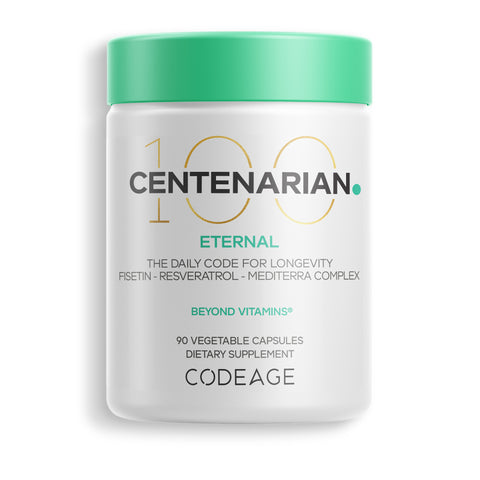
Within The Longevity Code, Centenarian 100 sits in the Cellular Longevity pillar.
Codeage, Cellular Longevity, Pillar 03
Centenarian 100
Fisetin from Rhus succedanea, resveratrol from Japanese knotweed and the Mediterra Complex of olive leaf, pomegranate and Gynostemma pentaphyllum extracts, in Codeage's Helix liposomal format, with phospholipids from non-GMO sunflower lecithin.
- Fisetin
- 500 mg
- Resveratrol
- 200 mg
- Mediterra Complex
- 900 mg
- Format
- Helix liposomal
Amounts per serving. Vegan. Formulated without dairy, soy, or gluten. Non-GMO. Manufactured in the USA in a cGMP-certified facility with global ingredients.
Shop Centenarian 100Continue reading
Further Reading from the Codeage Library
-
Cellular Longevity
The Smallest Architecture of Cellular Longevity
-
Aging biology
A Map of the Longevity Pathways
-
The teen years
The First Foundation of Every Decade After
-
The framework
The Longevity Code
Codeage, The Longevity Code
A System Built for the Long View
The Longevity Code is a four pillar daily system, every formula mapped to a specific dimension of how the body sustains itself across time.
Join The Code: The Longevity CodeStudies referenced were conducted independently and did not involve any specific Codeage product.
Centenarian 100 is not intended for those under the age of 18. Anyone who is pregnant or nursing, has a known medical condition or takes medication should speak with a qualified healthcare professional before use, and use should stop two weeks before surgery. Do not exceed the suggested use.
This article is educational and is not intended to diagnose, treat, cure, or prevent any disease. These statements have not been evaluated by the Food and Drug Administration.


