




 Start a live chat
 1-800-870-4800
Glutathione and vitamin C —
a cellular conversation
between two molecules.
Vitamin C and glutathione are usually described one at a time, as if each worked alone. In the cell, they do not. They sit inside a connected network of redox couples, each linked to the other, each able to take part in the other's cycle. The interesting story is not either molecule on its own — it is the conversation between them.
I
Two molecules that are usually described alone —
and in the cell are anything but.
Vitamin C and glutathione tend to be introduced separately. Vitamin C is the famous one — the molecule of citrus and long sea voyages, the first vitamin many people can name. Glutathione is the quieter one — the tripeptide the cell makes for itself, the subject of this whole series. Described one at a time, they seem like unrelated characters from different stories. But inside the cell they belong to the same story, and a great deal of the research literature on cellular redox biology is, in effect, about the conversation between them.
The reason the two are linked is that both are part of what biochemists call a redox network — a connected set of molecules that pass electrons among themselves. Each of these molecules exists in two forms: a reduced form, carrying spare electrons, and an oxidised form, having given them up. The network works because the molecules can hand electrons to one another, regenerating each other's reduced form in turn. Vitamin C and glutathione are two of the most studied participants in this network, and they sit close enough together that one can take part in the regeneration of the other. The article on the GSH and GSSG redox cycle sets out the two-form principle in detail.
This is the shift in perspective the cellular view asks for. The popular framing casts vitamin C as a thing the body uses up and glutathione as a thing the body makes, each on its own track. The cellular framing sees a web — many molecules, each cycling between forms, each connected to its neighbours, the whole thing held in balance by a shared flow of electrons. Vitamin C and glutathione are two threads of that web. Reading them together, rather than apart, is closer to how the cell actually runs its chemistry.
Described alone, they are two molecules.
Described together, they are a network.
The cell does not run them
on separate tracks.
The four parts of the network
Four players in the redox conversation —
the two molecules, the couple between them, and the engine beneath.
The vitamin C–glutathione relationship runs through a small set of connected parts. The cards below sketch the four the literature returns to most often.
I
Vitamin C
Ascorbate · the water-soluble member
Ascorbic acid — the dietary vitamin the body cannot make and must obtain from food. It cycles between a reduced form (ascorbate) and an oxidised form (dehydroascorbate), and that cycling is what places it inside the cell's redox network alongside glutathione.
II
Glutathione (GSH)
The cell's own tripeptide
Reduced L-glutathione — the molecule the cell synthesises from three amino acids and the most abundant participant in the network. It too cycles between reduced (GSH) and oxidised (GSSG) forms, and the literature has long studied its connection to ascorbate.
III
The redox couple
The link · electrons passed between them
The connection itself: glutathione has been described in the literature as able to take part in regenerating ascorbate from its oxidised form, returning vitamin C to its reduced state. The handoff of electrons between the two molecules is the heart of the conversation.
IV
NADPH
The engine beneath the network
The molecule that ultimately powers the regeneration of glutathione, drawn from the pentose phosphate pathway. NADPH sits beneath the whole network, supplying the electrons that keep the cycles turning — the engine room of the redox economy.
II
The recycling relationship —
how one molecule helps return the other to form.
The specific link between vitamin C and glutathione is one of regeneration. When ascorbate gives up its spare electrons, it becomes dehydroascorbate, the oxidised form. Left there, that form is short-lived and can break down. But the cell has ways of returning it to ascorbate, and glutathione has been described in the literature as one of the participants in that return — handing electrons to dehydroascorbate and returning it to the reduced ascorbate form. In this account, glutathione is part of how the cell keeps its vitamin C cycling rather than degrading. It is a relationship of mutual maintenance, written in the language of electrons.
Glutathione has its own regeneration story in turn, and this is where the network reveals its depth. When glutathione gives up electrons it becomes GSSG, the oxidised form, and an enzyme called glutathione reductase returns it to GSH — drawing the electrons it needs from NADPH. The whole arrangement is therefore a chain: NADPH supplies glutathione reductase, which maintains glutathione, which the literature connects to the maintenance of ascorbate. Each link depends on the one beneath it. The article on NADPH and the pentose phosphate pathway describes the engine at the bottom of this chain.
What makes this worth dwelling on is the idea of the network as a system rather than a list. The older way of thinking about dietary molecules regarded each as a single item with a single job. The cellular redox view sees them as an interacting set, where the standing of any one molecule depends on the others around it. Vitamin C and glutathione are the most-studied pair in that set, but they are part of a larger company — a company that includes the sulphur molecules this series has been mapping, from ergothioneine to the cysteine pool.
NADPH maintains glutathione.
Glutathione is linked to vitamin C.
Each part of the chain
depends on the one beneath it.
The network in numbers
Three observations on the vitamin C–glutathione relationship —
two forms, one link, and the engine beneath.
Two forms
Each molecule cycles between a reduced and an oxidised state — the basis of the whole network
Vitamin C cycles between ascorbate and dehydroascorbate; glutathione between GSH and GSSG. The redox network works because molecules in their reduced form can hand electrons to molecules in their oxidised form, regenerating one another in turn.
One link
Glutathione is described in the literature as a participant in regenerating ascorbate from its oxidised form
The connection most often discussed is glutathione's role in returning dehydroascorbate to ascorbate — keeping vitamin C cycling rather than degrading. A relationship of mutual maintenance between the two most-studied members of the network.
NADPH
The molecule beneath the network, supplying the electrons that keep the cycles turning
NADPH, drawn from the pentose phosphate pathway, powers glutathione reductase, which maintains the glutathione pool. The whole vitamin C–glutathione conversation rests on this underlying supply of reducing power.
III
Vitamin C and glutathione in the neighbourhood —
the water-soluble pair within the wider web.
To place vitamin C beside glutathione is to notice that they share a chemical territory. Both are water-soluble, which means both work within the watery interior of the cell and its compartments rather than in the fatty membranes — a contrast with the fat-soluble members of the broader network. Both cycle between two forms. Both are studied as participants in the same redox conversation. They are, in the cellular geography this series has been drawing, close neighbours occupying the same watery rooms of the cell, passing electrons across the short distance between them.
The wider network extends well beyond this pair. The literature describes an interconnected set of molecules — the fat-soluble members that work in the membranes, the enzymes that run the regeneration reactions, the sulphur compounds that occupy their own niches — all linked through the shared currency of electrons. Vitamin C and glutathione are the most prominent water-soluble pair within that set, the relationship the research returns to most often, but they are two nodes in a network the field continues to map. New work appears regularly on how the various members interact, how the balance shifts across tissues, and how the whole system is regulated.
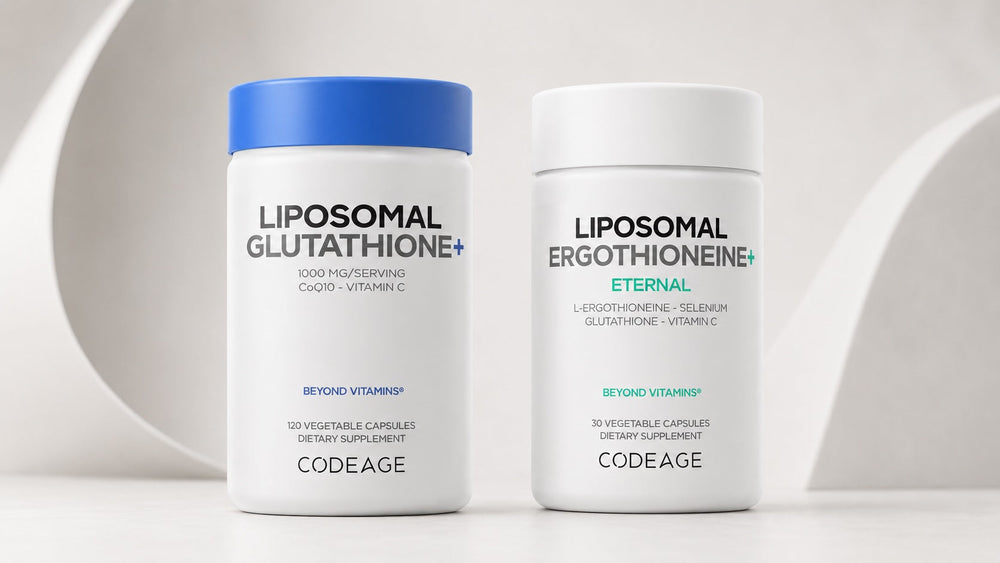
The contemporary Codeage catalogue brings the pair together directly. The Liposomal Vitamin C+ Platinum combines vitamin C with L-glutathione and other molecules in a single liposomal preparation, and the Liposomal Glutathione+ pairs glutathione with vitamin C and CoQ10 — the water-soluble pair brought together as they sit in the cell. Alongside the Liposomal Glutathione hero, these are part of the Pillar 03 architecture within the Longevity Code, where the molecules of cellular chemistry are housed as one coherent daily system. The literature on the cellular redox network continues to develop; the picture described here reflects the current understanding rather than a closed account. Studies referenced were conducted independently and did not involve any specific Codeage product.
Codeage · Cellular Longevity · Pillar 03
The water-soluble pair, together —
formats from the Pillar 03 line.
Vitamin C and glutathione, brought together as they sit in the cell — formulations from the Codeage glutathione line, in formats designed for daily use.
Liposomal Vitamin C+ Platinum
A liposomal vitamin C formulation built with L-glutathione, NAC, resveratrol, and rutin — molecules the literature has examined in connection with cellular redox biology, assembled in a single Helix Liposomal preparation.
View Product →Liposomal Glutathione
The flagship of the Codeage glutathione architecture. Reduced L-glutathione (GSH) supplied in a phospholipid vesicle format — the Helix Liposomal delivery system used in select Codeage formulations. The Pillar 03 anchor of the cellular redox conversation.
View Product →Liposomal Glutathione+
A combination liposomal format pairing reduced L-glutathione with vitamin C and CoQ10 — three molecules the literature has explored in the context of cellular redox biology, brought together in the Helix Liposomal vesicle architecture.
View Product →Previously in this series
Ergothioneine — The Other Sulphur Compound the Body Concentrates
Codeage · The Longevity Code
A network, not a list —
within one daily system.
The cellular pillar of the Longevity Code houses the tripeptide and the molecules it cycles with as parts of one coherent daily architecture.
Explore The Longevity Code →This article is provided for educational and informational purposes only and has been reviewed against FDA and FTC guidelines to ensure it does not make any health, disease, or treatment claim. Any research or studies referenced were conducted independently and did not involve Codeage products; no Codeage product has been used in any study or to establish, prove, or imply any benefit. These statements have not been evaluated by the Food and Drug Administration. Codeage products are not intended to diagnose, treat, cure, or prevent any disease.


