





 Start a live chat
 1-800-870-4800

The Thanksgiving Plate and the Building Blocks of Glutathione
One meal a year gathers more of the kitchen onto a single table than any other. Read closely, the Thanksgiving plate is also a parts list for a small molecule every cell assembles for itself.
In brief
Glutathione is a tripeptide that cells build from three amino acids: glutamate, cysteine and glycine. Of the three, cysteine is the one cells most often have least of, and its availability sets the pace of the first step of synthesis.
A Thanksgiving plate carries all three amino acids in its protein foods. A 1992 survey of everyday foods also measured glutathione itself, and found it spread unevenly across the different parts of a meal.
I
A Holiday Built Around One Table
Thanksgiving is the rare holiday defined almost entirely by a meal. The roast at the center, the vegetables around it, the stuffing, the bread, the cranberries, the pie that waits until later. It is a table assembled from many kitchens at once, and for a single afternoon it holds more of the year's food than most plates ever do.
That breadth makes it an unusually good place to look at food the way a cell does. A cell does not see a turkey or a dish of green beans. It sees amino acids, fats, sugars, minerals and the small compounds that plants and animals carry with them. Out of those parts it builds what it needs, and one of the things it builds, continuously, is glutathione.

Glutathione is a small molecule with a large presence. It is a tripeptide, three amino acids joined in a set order, and it is one of the most abundant small thiols inside cells, where it takes part in a wide range of everyday chemistry. The Codeage guide to the three amino acids that build glutathione sets out its structure in detail.
This article stays at the table. It asks a simple question of a familiar meal: where, on the plate, are the parts?

Three amino acids
Glutamate, Cysteine, Glycine
Joined in that order, they make the tripeptide every cell assembles for itself.
II
Three Building Blocks, One Small Molecule
Cells make glutathione in two steps, and each step spends energy in the form of ATP. In the first, an enzyme called glutamate cysteine ligase joins glutamate to cysteine. In the second, glutathione synthetase adds glycine to the end. The path is set out step by step in how the body makes glutathione.
The first step sets the pace. A review by Lu, 2013, on glutathione synthesis, in Biochimica et Biophysica Acta, described that step as rate limiting, governed by the activity of the enzyme and by how much cysteine the cell has on hand.
The three building blocks are not equally easy to come by. Glutamate is one of the most common amino acids in food and in the body. Glycine is plentiful too. Cysteine is the scarce one, the amino acid cells most often have least of, which is why it appears again and again in accounts of how glutathione is made.
Seen this way, the recipe is short and the shopping list is long. Three parts, two steps, and one ingredient that is always worth looking for.
Reading the table
Three Corners of the Plate
Each part of the meal carries something different: the amino acids, glutathione itself, or very little of either.
-

The roast
The Protein
Turkey and the other protein foods on the table carry all three amino acids. In the 1992 food survey, freshly prepared meats were also relatively high in glutathione itself.
-

The vegetables
The Greens
Green beans, sprouts, squash and the fruit on the table belong to the group the same survey found moderate to high in glutathione.
-

The bread basket
The Grains
Rolls, stuffing and the butter beside them fell into the groups that held little glutathione. They bring other things to the meal.
III
What a Food Survey Found on the Plate
Glutathione is not only made inside cells. Plants and animals make it too, so it is present in ordinary food. A widely cited attempt to measure it across an everyday diet is a study by Jones and colleagues, 1992, on glutathione in foods from a national food frequency questionnaire.
The team bought foods in the Atlanta area, prepared them as they are most commonly eaten in the United States and measured glutathione in each. Dairy products, cereals and breads were low. Fruits and vegetables were moderate to high. Freshly prepared meats were relatively high.
The study also looked at how food is kept. Frozen foods held glutathione at levels similar to fresh ones, while other forms of processing and preservation generally led to extensive losses. For a holiday table that mixes the freshly roasted with the canned and the boxed, that is a useful lens.
The survey measured what is on the plate. It did not follow what happens after the meal is eaten, and it reads more accurately as a map of food than as a statement about the body.
Studies referenced were conducted independently and did not involve any specific Codeage product.
The plate supplies the parts.
The cell does the assembly.
That is the whole recipe.
IV
Cysteine, the Scarce Ingredient
Cysteine is one of only two standard amino acids that carry sulfur, and that sulfur atom gives glutathione its working end, the thiol group. It is described as conditionally essential: the body can make it from methionine, the other sulfur amino acid, through a pathway called transsulfuration, but that route has limits, so cysteine from food still counts.
On the Thanksgiving table, the protein foods carry most of it. Poultry, eggs in the stuffing and the pie, dairy in the mashed potatoes and legumes all contribute, each in modest amounts. Cells also draw on cysteine for many other molecules, so the share that reaches glutathione is what remains after those needs are met.

The other two parts are easier to find. Glutamate is behind the savory depth of gravy and slow-cooked stock, and glycine is the most common amino acid in collagen, which is why a pot of broth on the stove, as described in bone broth season and the collagen in a winter kitchen, carries so much of it.
The vocabulary
Six Terms Behind the Plate
The words that appear in almost every account of how glutathione is made.
-
Tripeptide
A small molecule made of three amino acids joined in a set order. Glutathione is one.
-
Glutamate
The first amino acid in glutathione and one of the most common in food, behind the savory taste called umami.
-
Cysteine
The middle amino acid, and the only one of the three that carries a sulfur atom.
-
Glycine
The third amino acid and the smallest the body uses. The most common amino acid in collagen.
-
Thiol
A sulfur atom bonded to hydrogen. In glutathione it sits on cysteine and does most of the chemistry.
-
Rate-Limiting Step
The slowest step in a chain of reactions, which sets the pace for the whole. For glutathione it is the first.
V
A Table That Repeats
Thanksgiving comes once a year. The chemistry it illustrates does not. Cells build glutathione every day from whatever the ordinary plates of the week provide, which makes the everyday meal more telling than the holiday one.
That is the longevity view of food: less about a single feast than about the pattern of meals across years. The holiday table simply makes the pattern easy to see, with every part laid out at once.
Within The Longevity Code, glutathione sits in Cellular Longevity, the third pillar, which gathers the formulas concerned with the molecules cells use to sustain themselves over time. A pillar names a place in a framework. It describes a category, not an outcome for any reader.
Questions
What People Ask Most
What is glutathione made from?
Which of the three amino acids is the scarce one?
Do foods contain glutathione?
Does freezing or processing change it?
Where does glutathione sit in The Longevity Code?
One table, once a year.
Three amino acids, every day.
The Thanksgiving plate, read as the parts list for a small molecule.
Codeage, Cellular Longevity, Pillar 03
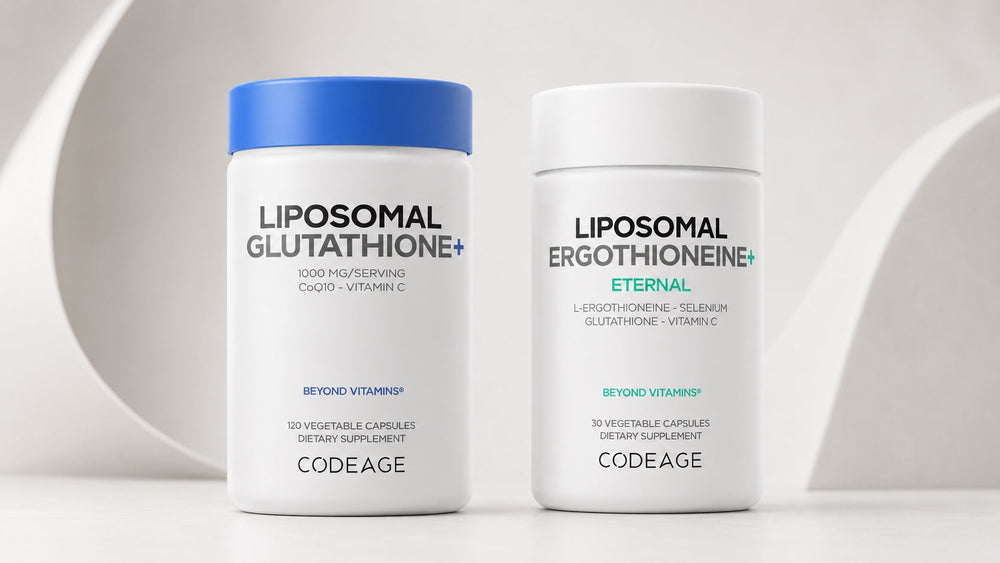
Liposomal Glutathione
Setria® L-Glutathione in Codeage's Helix liposomal format, with phospholipids from non-GMO sunflower lecithin, including phosphatidylcholine, in a methylcellulose capsule with microcrystalline cellulose.
- Glutathione
- Setria® L-Glutathione
- Per serving
- 500 mg
- Servings
- 30 per bottle
- Format
- Helix liposomal
Formulated without dairy, soy, or gluten. Non-GMO. Manufactured in the USA in a cGMP-certified facility with global ingredients.
Shop Liposomal GlutathioneContinue reading
Further Reading from the Codeage Library
Codeage, The Longevity Code
A System Built for the Long View
The Longevity Code is a four pillar daily system, with every formula mapped to a specific dimension of how the body sustains itself across time.
Join The CodeStudies referenced were conducted independently and did not involve any specific Codeage product.
Anyone who is pregnant or nursing, under 18, has a known medical condition or takes medication should speak with a qualified healthcare professional before using this product. Do not exceed the suggested use.
This article is educational and is not intended to diagnose, treat, cure, or prevent any disease. These statements have not been evaluated by the Food and Drug Administration.


