





 Start a live chat
 1-800-870-4800

Glutathione in Skincare Conversations, What Research Describes
Glutathione comes up often when people talk about skin, and the talk usually travels faster than the evidence. This is a plain account of what laboratory work, human trials and scientific reviews have described, and where the questions remain open. It is one thread in a larger longevity conversation about how cells keep their chemistry in balance over time.
In brief
Glutathione enters discussions of skin through two lines of biology: its role in the chemistry that decides which type of melanin a pigment cell makes, and its place in the antioxidant network of skin cells exposed to light. Most of that work comes from laboratory studies, and it is the second line, redox balance inside the cell, that also places glutathione at the center of longevity research.
Human research is smaller and more mixed. A handful of short randomized trials have measured skin properties in people taking glutathione by mouth, and published reviews describe the evidence as limited and call for larger, longer studies. The Philippine Food and Drug Administration has also cautioned against injectable glutathione used for skin lightening, in a July 2019 advisory reported by the Philippine Daily Inquirer.
I
How Glutathione Entered the Skin Conversation
Glutathione is present in nearly every cell of the body, and skin is no exception. The outer layers of skin are made largely of keratinocytes, with pigment producing melanocytes scattered among them, and both cell types carry their own supply of the tripeptide. The distribution map of glutathione in the body places skin among many tissues where it is found.
Skin is also the tissue most directly exposed to sunlight and air. That exposure makes it a natural place for researchers interested in how cells handle oxidative chemistry, and glutathione is one of the molecules they study there.
The second reason is pigment. Since the middle of the twentieth century, biochemists have described how sulfur containing molecules, glutathione and cysteine among them, take part in the reactions that produce melanin. That laboratory finding is the root of most modern discussion of glutathione and skin tone.
Between a reaction observed in a laboratory and a visible change in a person lies a long distance. This article follows the research across that distance, step by step, and notes where it stops.
The research record
Where the Evidence Stands
The main kinds of research behind the discussion, each with what it rests on.
| Type of research | What was examined | What it rests on |
|---|---|---|
| Laboratory studies | How glutathione and cysteine take part in the chemistry of pigment cells, including the step that decides between the two main melanin types | Cell and biochemical experiments, not studies in people |
| Oral trial, 2017 | Melanin index, UV spots, wrinkles, elasticity and skin hydration in women taking 250 mg of reduced or oxidized glutathione daily, or a placebo, for 12 weeks | 60 women enrolled, aged 20 to 50, in Bangkok; funded by the ingredient manufacturer |
| Narrative review, 2016 | Proposed mechanisms in melanin chemistry, and the oral, topical and injectable forms in use | Authors' reading of the published literature; called for larger, longer trials |
| Evidence appraisal, 2020 | Three randomized trials of glutathione taken by mouth or by injection, appraised for strength of evidence | Concluded the trials did not establish a consistent effect on skin tone |
| Regulatory advisory, 2019 | Injectable glutathione used for skin lightening | The Philippine Food and Drug Administration stated that no injectable product is approved for that use |

Skin, light and the chemistry of pigment.
II
Two Pigments and a Sulfur Atom
Melanin is made inside melanocytes, starting from the amino acid tyrosine. An enzyme called tyrosinase converts tyrosine into a reactive intermediate, dopaquinone, and what happens to dopaquinone next decides the kind of pigment the cell produces.
When little sulfur is available, dopaquinone moves toward eumelanin, the brown to black pigment. When sulfur containing molecules are present, dopaquinone reacts with them and the pathway turns toward pheomelanin, the yellow to red pigment. Cysteine is the main sulfur donor in this step, which is why the three building blocks described in glutamate, cysteine and glycine, the amino acids that build glutathione, matter to pigment biology.
Laboratory studies have proposed several further roles for glutathione in pigment cells, including interaction with tyrosinase itself. These observations come from cells and test tubes.
Most skin color is the sum of how much melanin is made and in what proportion of the two types, along with the thickness of skin and blood flow beneath it. Pigment is one variable among several, and a molecule that touches one step of its chemistry is one influence among many.
III
Antioxidant Chemistry at the Surface
Ultraviolet light striking skin generates reactive oxygen species, short lived molecules that react with whatever is nearby. Skin cells handle this through a network of antioxidant molecules and enzymes, and glutathione is one of its members alongside vitamin C, vitamin E and others.
Within that network, glutathione works through its sulfur atom. Reduced glutathione gives up electrons and becomes oxidized, and the cell converts it back again, a cycle traced in the redox cycle of reduced and oxidized glutathione. Researchers measure the balance between the two forms as one way of describing a cell's oxidative state.
This is the second thread that ties glutathione to skin, and it explains why the molecule is studied there. It is also the thread that connects skin research to longevity science, which looks at how cells maintain their redox balance across a lifetime, in skin as in every other tissue.

In the laboratory
Chemistry, Before Conclusions
What happens in a dish of pigment cells is a reason to keep studying. It is not yet a description of what happens in a person.
IV
What the Human Studies Report
The most detailed trial of glutathione taken by mouth and measured in skin was published by Weschawalit and colleagues, 2017, in Clinical, Cosmetic and Investigational Dermatology. Sixty healthy women aged 20 to 50 in Bangkok were enrolled to take 250 mg a day of reduced glutathione, oxidized glutathione or a placebo for 12 weeks, and 57 were included in the final analysis. The team measured melanin index, UV spots, wrinkles, elasticity and hydration.
Across the whole group, the differences between glutathione and placebo on the main measure were not statistically significant. The authors reported differences at particular skin sites and in participants over 40, described the work as preliminary, and noted that every participant was an Asian woman in a narrow age range. The ingredient manufacturer, Kyowa Hakko Bio, supplied the glutathione and funded the study.
Reviews read the wider record cautiously. A narrative review by Sonthalia, Daulatabad and Sarkar, 2016, in the Indian Journal of Dermatology, Venereology and Leprology found only a few small, short trials and called for larger and longer ones. An appraisal by Sitohang and Ninditya, 2020, in Dermatology Research and Practice examined three randomized trials and concluded that they did not establish a consistent effect on skin tone.
Taken together, the human research is early, small and mixed. Studies referenced were conducted independently and did not involve any specific Codeage product.
A plausible mechanism
is a reason to study,
not a result.
Four routes
Four Ways Glutathione Is Used
Each route is studied differently, and findings for one do not carry over to another.
-

Food
On the plate
Glutathione occurs naturally in many foods, including vegetables such as asparagus and spinach.
-

By mouth
Oral forms
Capsules and powders, examined in a small number of short randomized trials.
-

On the skin
Topical forms
Creams and lotions applied to skin, studied separately from forms taken by mouth.
-

By injection
Injectable use
Not approved for this purpose by the Philippine regulator, and approached with caution in published reviews.
V
Reading the Research With Care
Because so much of what is said about glutathione and skin rests on early work, a few questions help separate the research from the retelling. Which route was studied: food, a capsule, a cream or an injection? How many people took part, for how long, and was there a placebo group?
Who was studied matters as much. The 2017 trial enrolled women of one age range, living in one city, nearly all with the same skin phototype. Its authors were clear that wider populations would need their own studies before any general statement could be made.
Funding and the gap between measurement and appearance matter too. A difference on an instrument such as a melanin meter is not the same as a difference a person would notice. A careful reader holds these steps apart.
VI
Where This Fits in Longevity
Within The Longevity Code, glutathione sits in Cellular Longevity, the pillar concerned with the chemistry that sustains each cell over time. Skin itself belongs to Structural Integrity, the pillar of the tissues that give the body its form, explored in the structural story of collagen beneath the skin.
One distinction bears stating plainly. The research described here concerns biology and published studies. Codeage does not present Liposomal Glutathione as changing skin tone or the appearance of skin.
What the research offers instead is a clearer picture of a molecule that appears in the skin's own chemistry, and an honest sense of how much remains to be learned about it. That same restraint is how Codeage reads longevity science as a whole.

Open questions
Many Conversations, One Chemistry
Pigment chemistry, antioxidant chemistry and a small body of human research, each read on its own terms.
The vocabulary
Six Terms Behind the Research
The words that appear in almost every account of glutathione and skin.
-
Melanocyte
The pigment producing cell of the skin, found among the keratinocytes of the outer layer.
-
Tyrosinase
The enzyme that begins melanin production by converting the amino acid tyrosine.
-
Dopaquinone
The reactive intermediate whose next reaction decides which type of melanin is made.
-
Eumelanin
The brown to black pigment, favored when little sulfur is available to dopaquinone.
-
Pheomelanin
The yellow to red pigment, formed when dopaquinone reacts with sulfur containing molecules.
-
Melanin index
A reading from an instrument that measures pigment in skin, used as a research measure.
Questions
What People Ask Most
Why is glutathione discussed in skincare?
Has oral glutathione been studied for skin in people?
What do scientific reviews conclude?
Is injectable glutathione approved for skin lightening?
Where is glutathione found in skin?
How does glutathione relate to longevity?
Does Codeage make skin claims for Liposomal Glutathione?
Two lines of chemistry, one careful reading.
The evidence, step by step.
Glutathione and skin, from the melanin chemistry of pigment cells to the small human trials and the reviews that weigh them. One chapter in how longevity science reads the body's largest organ.
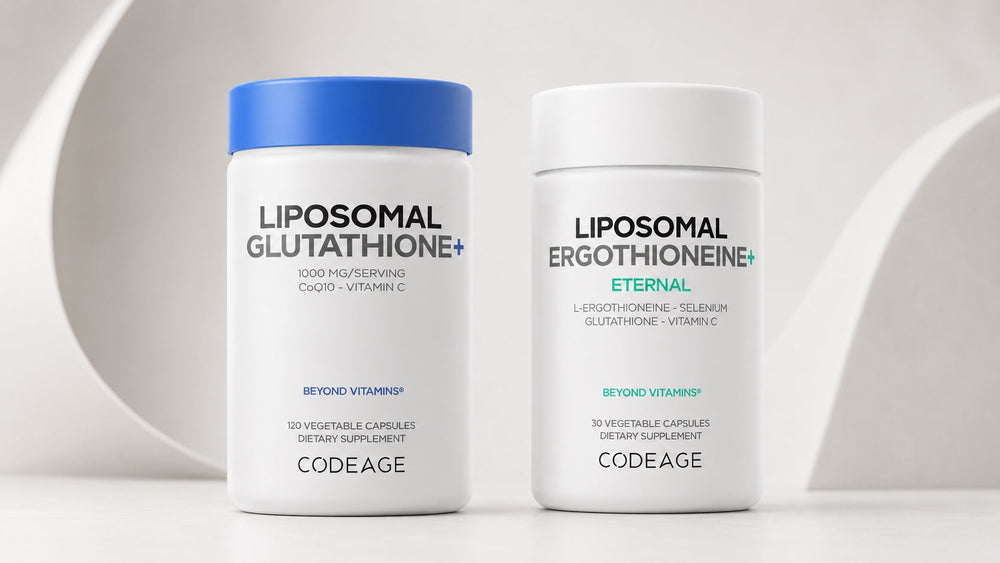
Setria® L-Glutathione in Codeage's Helix liposomal format.
Shop Liposomal GlutathioneContinue reading
Further Reading from the Codeage Library
-
Education
Hair Pigment, a Plain Guide to How Hair Gets Its Color
-
Education
Glutathione and Vitamin C, a Cellular Conversation
-
Education
Ceramides, the Lipids Behind the Skin's Surface
-
The framework
The Longevity Code
Codeage, The Longevity Code
A System Built for the Long View
The Longevity Code is a four pillar daily system, every formula mapped to a specific dimension of how the body sustains itself across time.
Join The Code: The Longevity CodeThis article is educational and is not intended to diagnose, treat, cure, or prevent any disease. Studies referenced were conducted independently and did not involve any specific Codeage product. These statements have not been evaluated by the Food and Drug Administration.


