







 Start a live chat
 1-800-870-4800

Why Glutathione Trends Every January
When the calendar turns, many people begin the year by looking again at their daily routine. Glutathione is one of the names that comes up along the way, and the reasons say as much about January as about the molecule itself.
In brief
Interest in glutathione rises each January because the new year is a natural moment to review daily habits, a pattern behavioral researchers call the fresh start effect. Glutathione itself is a small molecule built from three amino acids, made inside nearly every cell of the body.
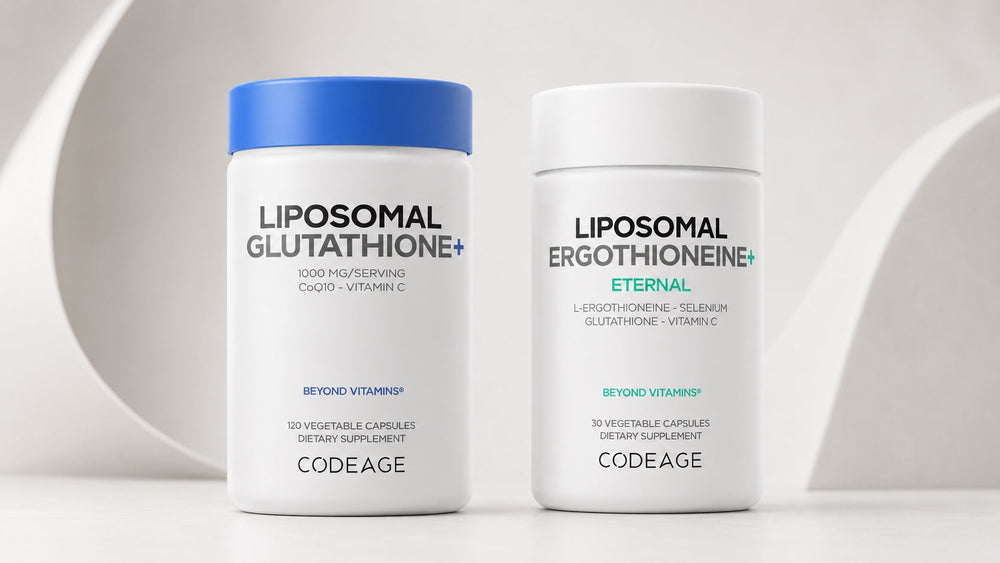
Liposomal Glutathione provides 500 mg of Setria® L-Glutathione per serving, in Codeage's Helix liposomal format, with phospholipids from non-GMO sunflower lecithin.
I
The Pull of a Fresh Start
Every January brings the same quiet ritual. Calendars are replaced, routines are reconsidered and people take stock of the small habits that fill an ordinary day: when they sleep, what they eat, how they move and what they read about.
Researchers have studied why the first day of a year carries so much weight. In Dai, Milkman and Riis, 2014, The Fresh Start Effect: Temporal Landmarks Motivate Aspirational Behavior, published in Management Science, the authors looked at three kinds of everyday behavior: online searches for the word diet, visits to a university gym and goal commitments made on a public website.
All three rose after what the authors called temporal landmarks, the start of a new week, month, semester or year, as well as birthdays and holidays. Their explanation was that these dates feel like a clean page, a moment that separates the past from what comes next.
January 1 is the most widely shared of those landmarks. It is the time of year when people are most inclined to read, ask questions and look again at the parts of a routine they usually leave alone. Glutathione is one of the subjects they turn to.
The molecule at a glance
Glutathione in Five Lines
The essentials of the molecule, from its name to the two forms it takes inside the cell.
| Feature | What it describes |
|---|---|
| Structure | A tripeptide, three amino acids joined in a short chain: glutamate, cysteine and glycine |
| Where it is made | Inside the cell, in two steps, each carried out by its own enzyme |
| Key feature | A sulfur-containing thiol group, carried by cysteine |
| Two forms | Reduced glutathione, written GSH, and oxidized glutathione, written GSSG |
| In the record | First observed in 1888, named in 1921, structure confirmed in 1935 |

A new year, and a new look at the everyday.
II
A Small Molecule Made in Every Cell
Glutathione is a tripeptide, a chain of just three amino acids: glutamate, cysteine and glycine. Like L-theanine, described in the L-theanine science review, it is built from amino acids without being a protein in its own right.
The body does not need to take glutathione in to have it. Nearly every cell makes its own. According to Lu, 2013, Glutathione Synthesis, published in Biochimica et Biophysica Acta, the process takes two steps, each carried out by its own enzyme, and the supply of cysteine is often what sets the pace.
The cysteine in the chain carries a thiol group, a sulfur atom bonded to hydrogen, and that group defines much of what glutathione does chemically. It allows the molecule to move between two forms, reduced glutathione and oxidized glutathione, a cycle traced in how GSH and GSSG cycle within the cell.
The way Codeage reads sources such as these is set out in Codeage science and standards. Studies referenced were conducted independently and did not involve any specific Codeage product.
III
A Name Given a Century Ago
The molecule entered the scientific record long before anyone knew its structure. In 1888 the French scientist Joseph de Rey-Pailhade observed a substance in yeast extract that reacted readily with sulfur. He called it philothion, from Greek roots meaning sulfur loving.
In 1921 the English biochemist Frederick Gowland Hopkins isolated the substance and gave it the name it carries today, joining glutamic acid with the thiol group at its center. The full three-part structure was confirmed in 1935.
Since then glutathione has become one of the most studied small molecules in cell biology, appearing in research on cells, tissues and the chemistry of daily metabolism. Its long scientific history is traced in the long history of glutathione research.

The turn of the year
A Clean Page in the Calendar
January invites a second look at the habits that fill an ordinary day.
IV
Why January Brings the Questions
The questions people ask in January tend to be about foundations. What do the meals of an ordinary week contain? How much sleep do the long winter nights allow? What does the body make on its own, and what does it draw from food?
Glutathione sits at the meeting point of those questions. It is something the body produces itself, yet it is assembled from amino acids that arrive through the diet. That makes it a natural subject for anyone thinking about the link between daily habits and the chemistry inside each cell.
It also follows naturally from December. The holiday season is a time of rich, shared meals, and the start of a new year is when many people return to a simpler, steadier pattern of eating, sleeping and moving. Reading about the molecules behind that pattern is part of the same return.
Seen this way, the January interest is less about a single molecule than about a moment. A new calendar gives people permission to understand their routine more closely, and glutathione is one of the places that curiosity leads.
The calendar turns.
The cell keeps its rhythm.
The routine begins again.
Three amino acids and a name
Four Words Behind the Molecule
The building blocks of glutathione, and the form found in Liposomal Glutathione.
-

Glutamate
The first link
An amino acid joined to cysteine through an unusual bond at the end of its side chain.
-

Cysteine
The sulfur center
The amino acid that carries the thiol group at the heart of the molecule.
-

Glycine
The final piece
The smallest amino acid, added in the second step to complete the chain.
-

Setria®
The named form
Reduced L-glutathione produced through fermentation in Japan by Kyowa Hakko Bio.
V
The Building Blocks on the Winter Table
The three amino acids in glutathione are familiar parts of an everyday diet. Glutamate is among the most common amino acids in protein foods of every kind. Glycine is especially plentiful in collagen-rich foods such as slow-simmered bone broth. Cysteine, the sulfur-containing link, is found in eggs, poultry, fish, legumes and whole grains.
A winter table already holds many of these foods. A pot of lentil soup, a roast chicken, eggs at breakfast and a bowl of broth on a cold evening all bring the building blocks of glutathione into an ordinary week. The same idea, applied to a holiday meal, is explored in the Thanksgiving plate and the building blocks of glutathione.
This is part of why January is a good time to think about glutathione at all. The questions it raises are about the shape of a whole routine, from the plate to the cell, rather than about any single change.
VI
Where This Fits in Longevity
Longevity is built across decades, yet it is lived one routine at a time. A new year is simply a convenient moment to look at that routine again, and the habits that last tend to be the ones that feel ordinary by February.
Within The Longevity Code, glutathione belongs to Cellular Longevity, the pillar that gathers the formulas concerned with the life of the cell. The pillar names a place in the daily routine. It does not describe an outcome.
Liposomal Glutathione is built around Setria® L-Glutathione, a reduced form of the molecule produced through fermentation. Where that name comes from, and what it tells a reader, is set out in the provenance of Setria L-glutathione.

A quiet morning at the start of the year.
A new year, a familiar molecule.
The questions start in January.
The fresh start of a new calendar brings people back to the basics of a routine, and to the molecules behind it.
The vocabulary
Six Terms for the New Year
The words that come up when glutathione is read about closely.
-
Fresh start effect
The tendency to pursue new goals after dates that feel like a new beginning, such as January 1.
-
Tripeptide
A short chain of three amino acids, the structure of glutathione.
-
Thiol group
A sulfur atom bonded to hydrogen, carried by the cysteine in glutathione.
-
GSH
Reduced glutathione, the form in which the thiol group is free.
-
GSSG
Oxidized glutathione, two molecules joined through their sulfur atoms.
-
Setria®
The trade name for reduced L-glutathione produced through fermentation by Kyowa Hakko Bio.
Questions
What People Ask Most
Why do people look up glutathione in January?
What is glutathione?
How does the body make glutathione?
What is the difference between GSH and GSSG?
Who discovered glutathione?
What is Setria L-Glutathione?
Three amino acids, one molecule.
One season to read about it.
Why glutathione draws attention each January, from the fresh start of a new calendar to the small molecule made in nearly every cell.
Within The Longevity Code, Liposomal Glutathione sits in the Cellular Longevity pillar.
Codeage, Cellular Longevity, Pillar 03
Liposomal Glutathione
Setria® L-Glutathione, reduced L-glutathione produced through fermentation, in Codeage's Helix liposomal format, with phospholipids from non-GMO sunflower lecithin.
- Setria® L-Glutathione
- 500 mg
- Servings
- 30
- Format
- Helix liposomal
- Capsule
- Methylcellulose
Amounts per serving. Formulated without dairy, soy, or gluten. Non-GMO. Manufactured in the USA in a cGMP-certified facility with global ingredients.
Shop Liposomal GlutathioneContinue reading
Further Reading from the Codeage Library
-
Precursors
Glutathione and Its Precursors
-
New year
Collagen and a New Year Training Routine
-
Aging biology
Why Healthspan Matters as Much as Lifespan
-
The framework
The Longevity Code
Codeage, The Longevity Code
A System Built for the Long View
The Longevity Code is a four pillar daily system, every formula mapped to a specific dimension of how the body sustains itself across time.
Join The Code: The Longevity CodeStudies referenced were conducted independently and did not involve any specific Codeage product.
Articles in the Codeage library are reviewed under the Codeage medical review standard.
Liposomal Glutathione is not intended for those under the age of 18. Anyone who is pregnant or nursing, has a known medical condition or takes prescription or over-the-counter medication should speak with a qualified healthcare professional before use, and use should stop two weeks before surgery. Do not exceed the suggested use.
This article is educational and is not intended to diagnose, treat, cure, or prevent any disease. These statements have not been evaluated by the Food and Drug Administration.


