






 Start a live chat
 1-800-870-4800
A Modern Case Study in
Multi-Source Collagen Design
Collagen diversity should be intentional — not incidental. Codeage Multi Collagen Protein Powder brings together five collagen types from five distinct food sources in a single unflavored daily powder.
Five Sources · Five Types · One Foundation
Not a maximalist formula. A response to a question the category had largely avoided: what does intentional collagen diversity actually look like?
I
How collagen
became familiar
For many people, collagen became familiar in a single form: hydrolyzed bovine peptides, often centered on type I. It is a good and widely used form — and for a great many daily routines, it is exactly enough.
But collagen is not one material. It is a family of related proteins, distributed across different tissues and different food sources. That fact opens a question no single source can fully answer alone: what would it look like to bring more of that family together, on purpose?
Codeage Multi Collagen Protein Powder is one answer to that question — not a correction of anything, but a deliberate intention. It is a premise that runs through Codeage's Structural Integrity pillar, where focused single-source formulas sit alongside multi-source ones, each built for a different purpose.

Codeage Multi Collagen Protein Powder · Unflavored
Not simply more collagen —
collagen by design.
II
Five types, five sources —
what intentional diversity means
Collagen is not a single protein. It is a family. At least twenty-eight types have been described in the scientific literature. Among them, the five most studied — types I, II, III, V, and X — are found in different tissues, occupy different structural roles, and are commonly associated with different biological sources.
No single animal source provides all five types in meaningful concentrations. This is why source diversity, when it is intentional, matters — not as a point of differentiation, but as a formulation principle. Codeage Multi Collagen Protein Powder draws from five distinct food sources: grass-fed hydrolyzed bovine collagen peptides (BSE-free), organic chicken bone broth, organic beef bone broth (BSE-free), wild-caught hydrolyzed fish collagen peptides from cod and snapper, and eggshell membrane collagen.
Each source contributes a different collagen type profile. Each delivers a different amino acid distribution. The result is not simply more collagen peptides. It is collagen diversity by design — types I, II, III, V, and X drawn together in one formula.
The Five Most Studied Types
One family,
several structures
Each collagen type is commonly associated with a different tissue and a different structural role. A multi-source formula is the practical way to represent more than one of them.
I
Type I
The most abundant collagen in the human body. Commonly associated with skin, tendon, and the connective matrix.
II
Type II
Primarily associated with cartilage and the cushioning tissues of the joints.
III
Type III
Found alongside type I in many tissues; among the most abundant types in the body.
V
Type V
Associated with cell surfaces and the early formation of tissue and fibers.
X
Type X
Found in mineralizing cartilage, where bone and cartilage meet.
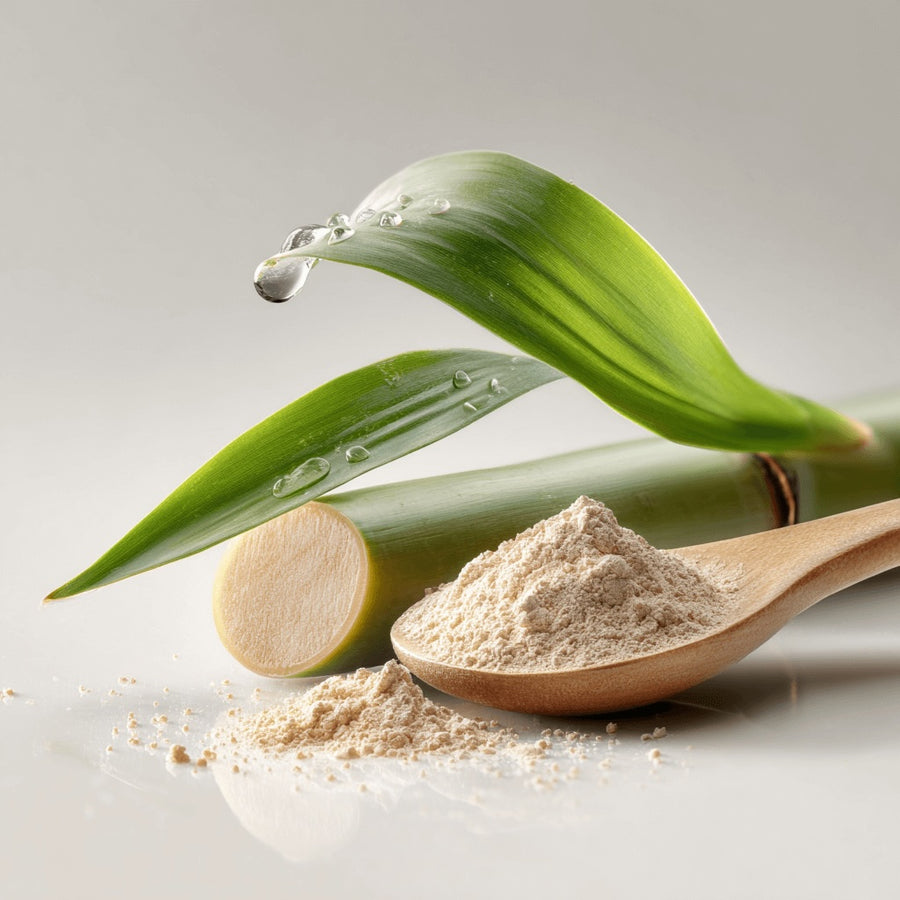
Types I, II, III, V & X · From Five Food Sources
The Raw Material Begins at the Source
Grass-fed bovine. Wild-caught marine. Organic broths. Eggshell membrane. The distinction begins at the farm and the ocean — not at the factory.
III
The sourcing layer
most never see
When someone picks up a collagen powder, the question they usually ask is how many grams per serving. Rarely do they ask where the collagen came from, how the source animal was raised, or what standards govern the raw material supply chain. Yet those questions describe the character of a collagen formula far more completely than the gram count on the front.
Grass-fed and pasture-raised bovine is a different raw material than commodity-grade collagen. Wild-caught fish collagen from cod and snapper reflects a sourcing philosophy that begins with an ocean rather than a feedlot. Eggshell membrane collagen comes from a source many formulas never consider — or do not hold the supply relationships to include.
These are not premium additions to a label. They are upstream decisions about raw material integrity. They are rarely visible to the person holding the canister — and yet they shape what is inside it every single day.
The gram count tells you how much.
The source tells you what.
IV
Eighteen amino acids —
the overlooked dimension
The collagen conversation is almost always framed around types: type I, type II, type III. There is another dimension of collagen protein that receives far less attention — the amino acid profile.
Collagen peptides are unusually rich in glycine, proline, and hydroxyproline, amino acids that are difficult to obtain in meaningful quantities from everyday eating. But the full profile extends much further — eighteen amino acids in total, with eight of the nine essential amino acids represented. Collagen is not a complete protein in the traditional nutritional sense; it lacks tryptophan. This is occasionally framed as a limitation. It is not. Collagen protein was never meant to stand in for a protein shake. It is a specialized structural protein with a specific amino acid signature — one a multi-source formula presents in broader distribution than any single-source alternative.
Per Serving · Indicative Profile
The amino acid signature
2,100 mg
Glycine
1,219 mg
Proline
1,021 mg
Hydroxyproline
880 mg
Glutamic acid
780 mg
Alanine
660 mg
Arginine
500 mg
Aspartic acid
322 mg
Lysine
292 mg
Serine
256 mg
Leucine
18
Amino acids total
The amount of amino acids per serving may differ and may change over time across different productions. These figures are indicative only and represent the amount at the time of writing in a specific production.

Unflavored · Mixes into Coffee, Smoothies, Soups & Recipes
V
The clean standard
across five sources
A formula is increasingly read not only by what is included, but by what is left out. Codeage Multi Collagen Protein Powder is Non-GMO, gluten-free, dairy-free, and soy-free; it is unflavored, carries zero carbs, contains no shellfish, and is free from artificial flavors, colors, sweeteners, and preservatives.
For a collagen formula drawing from five separate animal sources, holding a clean profile across every input takes deliberate work. Each source — bovine, chicken, beef, fish, eggshell — independently meets the same exclusion standards, so the formula stays clean no matter how many origins it draws from.
NSF · cGMP · Third-Party Tested
NSF certified. Manufactured in the USA in a cGMP-certified facility. Third-party tested — across all five sources.
VI
NSF, cGMP, and
third-party testing
The contents of a collagen powder — its purity, its identity, the absence of contamination — cannot be verified at home. Independent, third-party certification exists to confirm them, source by source.
Codeage Multi Collagen Protein Powder carries NSF certification, one of the most recognized third-party verification standards. NSF certification ensures accurate labeling, exceptional safety, and outstanding quality. The product is manufactured in the USA in a cGMP-certified facility with global ingredients, and is third-party tested for purity.

NSF Certified · cGMP Manufactured · Third-Party Tested
VII
Collagen diversity
as a design principle
Collagen, by its very nature, is not a single thing. It is a spectrum — multiple types with distinct structural roles, multiple sources with different amino acid profiles, multiple tiers of quality defined by sourcing, farming, and manufacturing. A formula can meet that spectrum in more than one way. A focused single source can be exactly the right choice for a particular intention; a multi-source blend answers a different question — breadth across types and amino acid distribution, gathered in one place.
What matters is not the number of sources. It is whether the choice was made deliberately. The most considered approach to a daily collagen formula is to decide what it is for, and then to build it that way — the right sources, in the right combination, verified by the right standards. Collagen diversity should be intentional — not incidental.

Five Food Sources · One Daily Foundation
Conclusion
Five sources,
one foundation
Codeage Multi Collagen Protein Powder brings together five collagen types — I, II, III, V, and X — from five food sources: grass-fed hydrolyzed bovine collagen peptides, organic chicken bone broth, organic beef bone broth, wild-caught hydrolyzed fish collagen peptides, and eggshell membrane collagen, in a single unflavored powder. Eighteen amino acids. Zero carbs. Nine grams of collagen per serving. Sixty-three servings per 20 oz container — over two months of daily use.
Formulated for women and men. It mixes into coffee, smoothies, soups, teas, protein shakes, recipes, and baked goods, and is keto- and paleo-friendly. A more intentional approach to a daily collagen formula. Designed. Sourced. Verified.
Formulated without dairy, soy, or gluten. Non-GMO. Manufactured in the USA in a cGMP-certified facility with global ingredients. References to research describe independent work that did not involve any specific Codeage product.
Codeage · Structural Integrity · Pillar 02
Multi Collagen Protein Powder
Five collagen types from five food sources, in a single unflavored daily powder.
Multi Collagen Protein Powder
Grass-fed bovine, organic chicken and beef bone broth, wild-caught fish, and eggshell membrane collagen. Unflavored. Nine grams of collagen per serving.
View Product →Multi Collagen Protein Powder
The same five-source, five-type unflavored formula — grass-fed bovine, organic chicken and beef bone broth, wild-caught fish, and eggshell membrane collagen — in a one-month size.
View Product →Codeage · The Longevity Code
A system built for
the long view
The Longevity Code is a four-pillar daily system — every formula mapped to a specific dimension of how the body sustains itself across time.
Join The Code →


