




 Start a live chat
 1-800-870-4800
Why independent certification exists
in the supplement category —
a brief background.
The modern supplement category in the United States exists within a particular legislative backdrop — DSHEA, the Dietary Supplement Health and Education Act of 1994. The background is not a manual; it is the context that explains why independent certification programmes — NSF and USP — emerged in the first place, and why a brand might choose to participate in them.
I
DSHEA — the 1994 act that shaped the modern category —
and the context it created.
The Dietary Supplement Health and Education Act of 1994 — known as DSHEA — is the federal statute that defines how dietary supplements are regulated in the United States. The act amended the Federal Food, Drug, and Cosmetic Act and established the basic framework that has governed the category for three decades. The core decisions DSHEA made were three: dietary supplements are a category of food, not drugs; they do not require pre-market approval before being sold; and the FDA's enforcement role is post-market, addressing problems after products reach the shelf rather than vetting products before they appear.
The first decision — supplements as food, not drugs — was structural. Drugs in the United States go through a multi-stage approval process at the FDA before they can be sold: pre-clinical research, three phases of human trials, formal review, approval, and ongoing post-market monitoring. Food, by contrast, is not subject to the same pre-market approval process. By placing supplements on the food side of the regulatory line, DSHEA explicitly chose to keep them out of the drug-approval system. The reasoning at the time, debated extensively in Congress, was that supplements — long-used vitamins, minerals, botanicals — would sit on the food side of the regulatory line rather than within the pharmaceutical-approval system.
The second decision — no pre-market approval — followed from the first. A new dietary supplement can be formulated, labelled, manufactured in a cGMP-compliant facility, and placed on the market without the FDA having reviewed the specific product in advance. The manufacturer is required to notify the FDA of new dietary ingredients (ingredients that were not in the food supply before 1994) and to maintain documentation regarding safety, but the agency does not, in the ordinary course, grant or withhold approval for new products. The third decision — post-market enforcement — describes the agency's role: handling adverse-event reports, addressing mislabelling, taking action when problems surface. The structural consequences of these three decisions shape the entire conversation about supplement quality, and the role of independent certification within it. The NSF-verification article picks up here.
Supplements — regulated as food, not drugs.
No pre-market approval.
Post-market enforcement —
the framework chosen in 1994.
WHAT DSHEA REQUIRES
Five things the framework requires —
and where the gaps sit.
The cards below describe five elements of the DSHEA framework as it operates today. Each element answers a question about what is mandatory, what is voluntary, and where the system leaves space for third-party verification to fill in.
I
cGMP Manufacturing
21 CFR Part 111.
Every dietary supplement manufacturer in the United States is required to follow Current Good Manufacturing Practice as codified in 21 CFR Part 111. The regulation covers facility cleanliness, equipment, batch records, training, quality control. cGMP compliance is mandatory — the regulatory floor of the system.
II
Label Requirements
Statement of Identity, Supplement Facts, Other Ingredients.
The label must include defined elements — the product's statement of identity, a Supplement Facts panel with declared ingredients and amounts, the list of other ingredients, the manufacturer's name and address. The specific format is codified.
III
Adverse Event Reporting
Mandatory serious AE reports.
Manufacturers are required to report serious adverse events associated with their products to the FDA. This is post-market — events surface after a product reaches the market — and the reporting feeds the agency's surveillance function.
IV
NDI Notification
New Dietary Ingredients.
For ingredients not in the food supply before 1994 — New Dietary Ingredients — manufacturers must notify the FDA at least 75 days before marketing and submit safety information. The agency reviews the notification but does not approve the ingredient as such.
V
Third-Party Certification
NSF Certified, USP Verified.
Independent certification — NSF Certified, USP Verified — is voluntary. The brand chooses to submit specific products for outside audit. The framework deliberately leaves this layer to the market. The mark on the label identifies which products carry it.
II
What DSHEA does not do —
the deliberate gaps in the framework.
Reading DSHEA plainly also requires acknowledging what the framework does not require. It does not require pre-market approval of new dietary supplements. It does not require ingredient identity verification by an independent body before market entry. It does not require contaminant testing by anyone other than the manufacturer or its contract laboratories. It does not require ongoing post-market surveillance of identity or purity for products already on the shelf, beyond the adverse-event reporting system and inspections. These gaps are not oversights — they are the framework's design.
The gaps were deliberate choices made in 1994 to keep the supplement category outside the drug-approval system. The trade-off was explicit: lower regulatory burden in exchange for less pre-market scrutiny, with the assumption that market forces, manufacturer integrity, and post-market enforcement together would address quality concerns over time. Whether that assumption has held up in the three decades since is a matter of ongoing debate — but the framework's design is what it is, and operating within it requires understanding where the gaps sit. The cluster's contaminants article develops the testing side of this further.
The role of voluntary, third-party certification — NSF Certified, USP Verified — sits exactly at the gap. The marks fill, for specific products, the role the regulatory framework chose not to fill universally. They do not replace the regulatory framework; they layer on top of it. A product carrying an NSF Certified mark is still required to meet every mandatory DSHEA element (cGMP, label format, AE reporting, NDI notification where applicable); the NSF certification adds independent verification on top of those mandatory layers. Reading the framework this way clarifies why the certification marks matter — not because the regulatory system is broken, but because the system was deliberately designed to leave space for them.
Mandatory layers. Voluntary layers.
Each filling its own role —
the certification mark sits exactly
where the framework leaves space.
THE FRAMEWORK IN CONTEXT
Three observations about the regulatory landscape —
from the public record.
1994
The year DSHEA was passed by Congress and signed into law — establishing the framework that has governed dietary supplements for three decades.
Before 1994, supplements operated under a less clearly defined regulatory regime. DSHEA was a deliberate compromise between the dietary supplement industry, public health advocates, and Congress, designed to formalise the category without subjecting it to drug-approval requirements.
21 CFR Part 111
The federal regulation codifying cGMP requirements for dietary supplement manufacturers, in force since 2007.
cGMP for supplements was finalised more than a decade after DSHEA itself, in 2007, with phased implementation. The regulation sets the manufacturing floor that every dietary supplement maker in the United States must meet.
Post-market
The FDA's primary enforcement role for supplements is post-market — addressing problems after products reach the shelf, not vetting them in advance.
The agency handles adverse-event reports, mislabelling complaints, and enforcement actions against products that violate the regulatory framework. The role is real and the enforcement capacity is non-trivial, but it operates after products are already on the market.
III
What this means for a careful buyer —
reading the framework into the shopping decision.
For a buyer trying to make a careful supplement decision, reading the framework plainly is the foundation. cGMP compliance is mandatory — a product manufactured in a non-cGMP facility is not operating within the law. Label format is mandatory — a product without a Supplement Facts panel is not operating within the law. Beyond these mandatory layers, the variation is wide, and the certification marks (NSF Certified, USP Verified) are the public signal of which products their makers chose to submit for independent verification.
The Codeage NSF Certified range — publicly searchable on the NSF registry — including Multi Collagen Protein Powder, Liposomal Glutathione, Liposomal NMN Platinum, Liposomal Magnesium Glycinate — represents products that have been submitted to that voluntary, independent verification layer in addition to the mandatory regulatory baseline.
Reading the regulatory framework as it actually operates — not as it is sometimes misrepresented — is part of becoming a more careful buyer. The supplement category is not unregulated; it is regulated differently than drugs are regulated, with mandatory elements and deliberate gaps. The certification marks are the public indicator of which products their makers chose to submit to verification in those gap areas. The cluster's practical guide brings the framework and the marks together into a reading checklist.
Codeage · NSF Certified · Cross-Pillar Range
A selection of NSF Certified products —
from the Codeage range.
Codeage maintains an NSF Certified range across the four pillars of the Longevity Code. The cards below show three of the products that carry the mark.
Multi Collagen Protein Powder
An NSF Certified product in the Codeage range. Multi-source collagen protein powder — five collagen types in a single formula. Sits within Pillar 02 of the Longevity Code.
View Product →Liposomal Glutathione
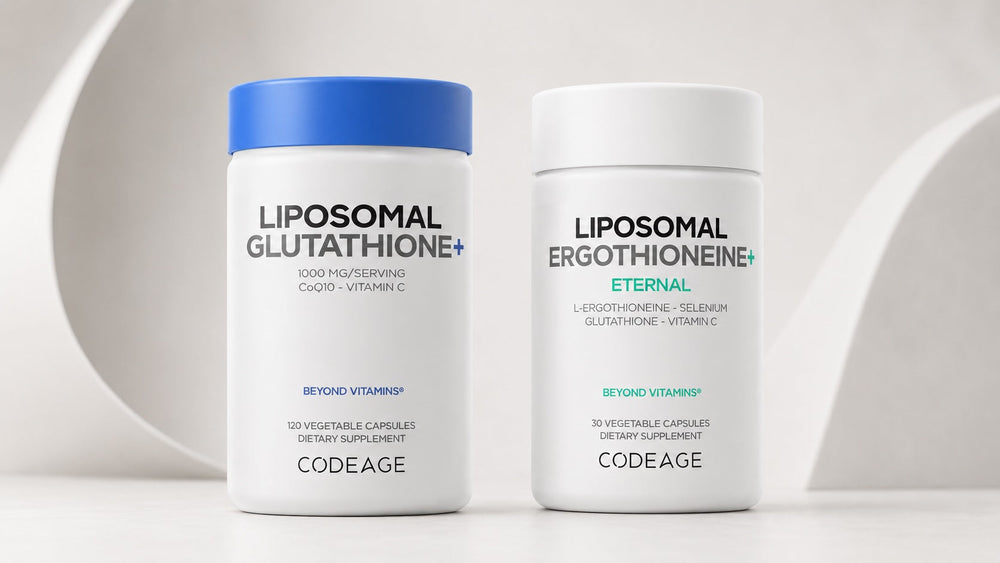
An NSF Certified product in the Codeage range. Reduced L-glutathione in a phospholipid vesicle format — the Helix Liposomal delivery system used in select Codeage formulations.
View Product →Liposomal Magnesium Glycinate
An NSF Certified product in the Codeage range. Liposomal magnesium glycinate, a chelated magnesium format in the Helix Liposomal vesicle architecture. Pillar 01 daily-foundation formulation.
View Product →Previously in this cluster
Third-Party Tested Supplements — What the Term Actually Covers
Codeage · The Longevity Code
A daily system —
built for the cellular long view.
The Longevity Code organises the body's daily chemistry into four pillars. The NSF Certified products sit across the architecture.
Explore The Longevity Code →


