




 Start a live chat
 1-800-870-4800
The sulphur atom —
a meditation on
the most underrated element in biology.
Sulphur is, in the popular imagination, the element of matchsticks and rotten eggs and biblical punishment. It is also the element on which an extraordinary amount of biology runs. The atom at the heart of glutathione. The atom underwriting every disulphide bond in every folded protein. The atom that almost nobody thinks about — and that quietly carries some of the most consequential chemistry in cellular life.
I
An element with a reputation —
and a quieter life behind it.
Sulphur arrives in human culture with a reputation that precedes the chemistry. The yellow stuff. The substance of matchsticks. The smell of struck flints, of struck matches, of struck industrial processes. The sulphurous of biblical hellfire. The brimstone of medieval imagination — brimstone being itself an old English word for sulphur, from the Middle English brennen (to burn). The element entered the language alongside fire, smell, and threat. It is one of the few elements with a place in poetry independent of its chemistry.
What gets less attention is the cellular life of the element. Inside every cell of every living organism on Earth, sulphur is at work. It sits at the centre of glutathione — the tripeptide the body produces in essentially every tissue, and the molecule the literature describes throughout this body of work. It sits at the heart of every disulphide bond — the chemical bridges that hold folded proteins in their three-dimensional shapes. It is in coenzyme A, in biotin, in iron-sulphur clusters that power cellular respiration, in the amino acids cysteine and methionine. It is in some of the smallest and most consequential reactions the cell carries out. The element is everywhere in the cell. The reputation, in this register, has no purchase.
The chemistry of biological sulphur runs through a single defining feature: the atom's capacity to gain and lose electrons. Sulphur sits in column sixteen of the periodic table, the column the chemists used to call the chalcogens. The column also contains oxygen — and the family resemblance is partly why sulphur does so much biological work. Like oxygen, sulphur can pick up and release electrons in patterns that move chemistry along. Unlike oxygen, sulphur is somewhat softer, somewhat more accommodating, somewhat more willing to participate in the bonds biology actually builds. The result is a chemistry that the cell can do delicately, in ways the cell's harder chemistry with oxygen cannot.
Carbon for the backbone.
Oxygen for the breath.
Nitrogen for the protein.
Sulphur for everything else.
The element behind the chemistry
the popular imagination forgets.
The element at work
Four places biological sulphur is found —
and what it is doing there.
The element appears across the cellular landscape in different chemical forms. The cards below list four of the most consequential — from the thiol surface of glutathione to the disulphide bridges holding folded proteins to the iron-sulphur clusters of cellular respiration.
I
The thiol group
-SH · the working surface
The most chemically reactive functional group containing sulphur. A single sulphur atom bonded to a single hydrogen, written -SH. The thiol is the working surface of glutathione, the reactive position on every cysteine residue, and one of the most versatile chemical handles the cell maintains.
II
Disulphide bridges
-S-S- · the structural bond
Two thiols joined together, the hydrogens released, forming an -S-S- bridge. Disulphide bonds hold the three-dimensional structure of many proteins together — insulin, antibodies, hair keratins. They are the chemistry behind the curl of hair, the function of antibodies, the stability of many hormones.
III
Iron-sulphur clusters
[Fe-S] · the electron carriers
Small clusters of iron and sulphur atoms that sit at the heart of many cellular electron-transport reactions. They are essential components of mitochondrial respiratory complexes — the machinery by which the cell extracts energy from food. Among the oldest chemical motifs in cellular biology.
IV
Sulphur amino acids
Cysteine and methionine
Two of the twenty amino acids the body assembles into proteins carry sulphur in their structures: cysteine (with a thiol) and methionine (with a thioether). They are the principal dietary entry points of biological sulphur — the sources from which the body's sulphur economy is supplied.
II
The thiol group, the disulphide bridge —
two ways the element works inside cells.
The principal chemical functional group in which biological sulphur appears is the thiol — a sulphur atom bonded to a hydrogen, written -SH. The thiol is one of the most chemically reactive functional groups the cell maintains. It can donate electrons. It can accept electrons. It can bond to another thiol to form a disulphide bridge — and then the bridge can be broken again, with the right enzyme, returning the two original thiols. The thiol is, in a sense, the cell's most versatile chemical handle. It is the part of glutathione that does the molecule's work, and it is the part of every cysteine residue in every protein that — when the cell needs it to — forms a structural bond. The introductory article describes the thiol's role in glutathione specifically.
The disulphide bond is the second of the two principal forms biological sulphur takes. A disulphide is two thiols joined together, the two hydrogens released, the two sulphur atoms now sharing electrons in a -S-S- bridge. The disulphide bond is what holds the three-dimensional structure of many proteins together. Insulin, the hormone that regulates blood sugar, has three disulphide bonds at the heart of its tertiary structure. Antibodies — the immune system's most diverse class of proteins — are held together by disulphide bridges between their heavy and light chains. Hair and nail proteins — keratins — are held in their characteristic shapes by extensive disulphide networks. The chemistry that hairdressers do with permanent waves and chemical straighteners is, in essence, the controlled breaking and re-forming of disulphide bonds in hair keratin. The element, again, doing structural work the popular imagination assigns to something else.
In glutathione, the thiol and the disulphide are the two faces of the same molecule. The reduced form (GSH) carries a free thiol. The oxidised form (GSSG) joins two molecules together by a disulphide bridge. The cellular cycle that converts one to the other and back — by way of the enzymes glutathione peroxidase and glutathione reductase — is the chemistry of the thiol-disulphide pair on continuous repeat. The whole apparatus, every cycle, every conversion, every regulatory loop, runs through the chemistry of the sulphur atom.
140 grams of sulphur
in a typical human body.
Not a large number.
But disproportionate
to the chemistry it carries.
Sulphur in numbers
Three facts about an element —
more consequential than its mass would suggest.
~140 g
The approximate total mass of sulphur in a typical adult human body
The human body contains roughly 140 grams of biological sulphur — about 0.2 percent of body mass. By mass it is the eighth most abundant element in the body, behind oxygen, carbon, hydrogen, nitrogen, calcium, phosphorus, and potassium. But the chemistry the 140 grams carries out is disproportionate to the modest mass.
Column 16
The position of sulphur in the periodic table — directly below oxygen in the chalcogen family
Sulphur sits in column sixteen of the periodic table, directly below oxygen. The family resemblance between the two — both can gain and release electrons in patterns the cell uses — is one of the reasons sulphur does so much biological chemistry. Unlike oxygen, sulphur participates in chemistry more delicately, in ways the cell's harder oxygen chemistry cannot.
2 of 20
The two sulphur-containing amino acids — cysteine and methionine — among the twenty the body uses
Of the twenty amino acids the body assembles into proteins, only two contain sulphur: cysteine and methionine. The body's sulphur economy enters through these two amino acids — the sources from which cellular sulphur pools, including glutathione, are supplied. The asymmetry between the abundance of sulphur amino acids and the cellular demand for sulphur is one of the recurring topics in the literature.
III
An underappreciated element —
and the cellular biology it quietly runs.
The popular treatment of biological elements tends to emphasise the obvious ones. Carbon — the backbone of organic chemistry. Oxygen — the breath of life. Hydrogen — the lightest and the most abundant. Nitrogen — the protein-forming element. These are the four that any introductory biology textbook leads with, and they are, by mass, the dominant elements in the human body. But behind these four, doing some of the most chemically consequential work in cellular life, sulphur sits quietly in the column-sixteen position. It accounts for only about 0.2 percent of the body's mass — meaning a typical adult human contains roughly 140 grams of biological sulphur. That is not a large number. But the chemistry the 140 grams carries out is disproportionate to the mass.
The two principal dietary sources of biological sulphur are the sulphur-containing amino acids: cysteine and methionine. Both appear in dietary protein; both contribute to the body's sulphur pool. Cysteine, the amino acid that sits at the middle of glutathione, is described in the literature as the rate-limiting substrate of cellular glutathione synthesis — meaning the cellular supply of glutathione is, in many tissues, governed by the availability of this one sulphur-containing amino acid. The amino acids article describes the chemistry of cysteine in detail.
And then there are the foods themselves. Asparagus carries some of the highest glutathione concentrations of any vegetable the literature has catalogued. The allium family — garlic, onion, leek, shallot — carries an entirely different sulphur chemistry, the organosulphur compounds responsible for the family's characteristic smell and taste. The cruciferous vegetables — broccoli, cabbage, kale, Brussels sprouts — carry yet another class of sulphur compounds. The sulphur vegetables article in this cluster takes up that conversation. The element is, in food terms, distributed everywhere in the diet — concentrated in some places, present in many. The 140 grams the body carries comes from the meals, dish by dish. Studies referenced were conducted independently and did not involve any specific Codeage product. The literature on biological sulphur continues to develop; the picture described reflects the current understanding rather than a closed account.
Codeage · Cellular Longevity · Pillar 03
The Codeage glutathione line —
formats from the Pillar 03 architecture.
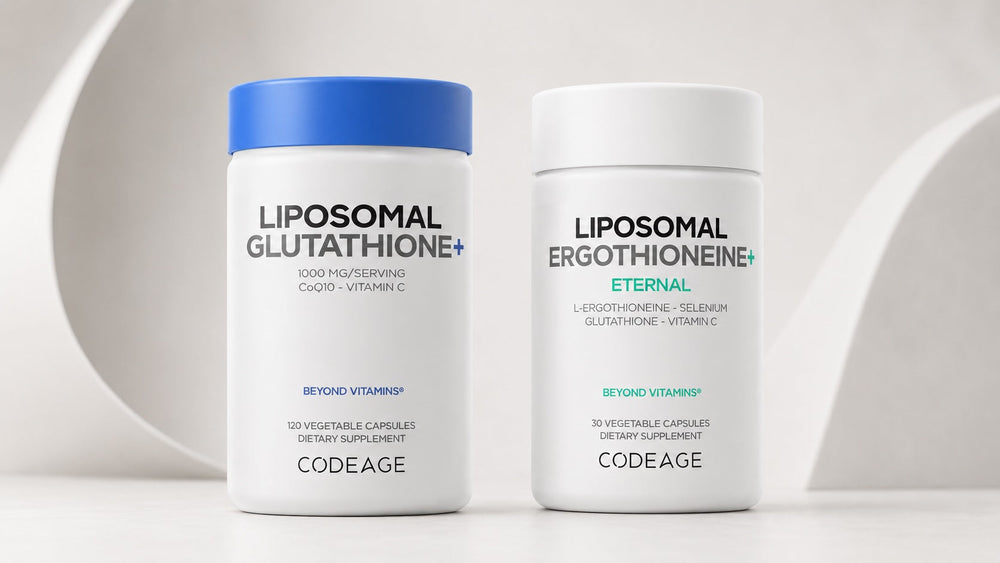
Formulations from the Codeage glutathione line — the tripeptide the body produces, in formats designed for daily use.
Liposomal Glutathione
The flagship of the Codeage glutathione architecture. Reduced L-glutathione (GSH) supplied in a phospholipid vesicle format — the Helix Liposomal delivery system used in select Codeage formulations. The Pillar 03 anchor of the cellular redox conversation.
View Product →L-Glutathione
Reduced L-glutathione presented in a classic non-liposomal format. The molecule itself, without the vesicle architecture, for those approaching the category in its most direct form.
View Product →Liposomal Vitamin C+ Platinum
A liposomal vitamin C formulation built with L-glutathione, NAC, resveratrol, and rutin — five molecules the literature has examined in connection with cellular redox biology, assembled in a single Helix Liposomal preparation.
View Product →Article B1 · Previously in this cluster
Yeast, Sulphur, and a French Chemist — The Discovery of Glutathione in 1888
Codeage · The Longevity Code
An overlooked element —
at the centre of the system.
Pillar 03 of the Longevity Code addresses the cellular molecules. Sulphur, present in trace amounts, runs much of the chemistry the pillar describes.
Explore The Longevity Code →


