




 Start a live chat
 1-800-870-4800
What NSF certification means
for a supplement —
a clear explanation of the standard.
NSF is one of the marks that appears on certain supplement labels. The letters carry a precise meaning — established by an independent organisation, applied through a defined audit process, and earned by individual products rather than entire companies. The literature is plain on what it is, what it tests, and what it does not.
I
What the letters NSF mean —
and what the certification covers.
NSF is the name of an independent, accredited organisation that operates from facilities in Ann Arbor, Michigan, with global testing sites. The organisation was founded in 1944 and has, over the decades since, become one of the principal certifying bodies for a range of products that touch the human body — drinking water systems, food equipment, restaurant fittings, and, since the late 1990s, dietary supplements. The mark exists because, in self-regulated categories where claims on labels are not pre-verified by the government, an independent body is the closest thing to a neutral referee.
When a supplement carries the NSF Certified mark — whether the basic NSF/ANSI 173 certification or the higher-bar NSF Certified for Sport mark — that specific product, in that specific formulation, manufactured in that specific facility, has been through the organisation's audit process. The audit covers what is in the bottle (does the label match the contents?), what is not in the bottle (are contaminants within defined thresholds?), and how the product is made (does the facility follow Good Manufacturing Practices, and does NSF periodically inspect it?). The mark is product-specific, not brand-wide. A company can have one NSF Certified product on its shelf and many that are not — the mark only travels with the specific SKU that earned it.
There is a second important distinction. NSF certification is not a verdict on whether a supplement works, whether the ingredients inside are biologically active, or whether the daily serving will deliver any particular outcome for the person who takes it. The mark addresses identity, purity, and manufacturing — what is in the bottle, what is not, and how it was made. The biological question — does this molecule do something in the body, and if so, what — remains the territory of the published research literature and the field of nutritional science. This series, the cluster's next article develops further, walks through what NSF actually verifies — and what it does not.
A neutral referee.
An audited mark.
A product-specific certification —
not a brand-wide endorsement.
WHAT NSF CERTIFICATION VERIFIES
Five things the NSF audit examines —
in plain language.
The NSF certification process is methodical. The cards below describe, in plain language, the five categories of inspection the audit covers — drawn from the publicly available NSF/ANSI 173 standard and the NSF Certified for Sport supplementary requirements.
I
Label Identity
Does the label match the bottle?
The audit verifies that the active ingredients listed on the supplement label are, in fact, present in the contents at the amounts the label states. Identity testing uses analytical methods appropriate to each ingredient — chromatography, mass spectrometry, microbiological assays.
II
Contaminant Limits
Below defined thresholds.
The audit verifies that the product does not exceed defined thresholds for heavy metals (lead, arsenic, cadmium, mercury), pesticide residues, herbicide residues, and microbial contamination. The thresholds are publicly documented in the NSF/ANSI 173 standard.
III
GMP Compliance
Manufacturing process audit.
The audit verifies that the facility manufacturing the product follows Good Manufacturing Practices (GMP) as defined by the FDA for dietary supplements. NSF auditors visit the facility, inspect documentation, and conduct site walks. GMP compliance is verified, not assumed.
IV
Banned Substance Screen
NSF Certified for Sport tier.
The higher-bar NSF Certified for Sport mark adds a screen for substances banned by major athletic organisations — currently more than 280 substances on the World Anti-Doping Agency and major sports league lists. The screen runs on every lot of certified product.
V
Ongoing Surveillance
Lot-by-lot verification.
NSF certification is not a one-time event. The organisation maintains ongoing surveillance — repeat audits of the manufacturing facility, retesting of products pulled from the market, and continuous verification that the certified product continues to meet the standard over time.
II
What NSF certification does not promise —
the boundary of the mark.
Understanding what NSF certification is requires also understanding what it is not. The mark does not promise that a supplement will produce a specific health outcome, address a specific condition, or work as advertised in any pharmacological sense. The mark does not adjudicate marketing claims that brands make in their advertising. The mark does not certify a brand as a whole — only specific products manufactured in audited facilities. The mark does not eliminate all conceivable risk; it documents that the audited product meets the audited standard.
These limitations are not accidental. They reflect the deliberate scope of the certification: identity, purity, and process. Other questions — efficacy, biological activity, individual tolerance, interaction with other substances a person takes — sit outside the NSF mandate and are addressed, when they are addressed at all, by other parties: the researchers who publish in peer-reviewed journals, the clinicians who advise individuals, the regulatory bodies that handle adverse-event reports. NSF's contribution is bounded but precise. The comparison article in this cluster places the NSF mark alongside the other major certification frameworks.
The reason this matters for someone trying to read a supplement label is that the NSF mark, where it appears, is a verified data point — but it is a specific data point. A label can carry NSF Certified for Sport and still leave open every question of whether the ingredient inside is the right molecule for that person's situation. That is a separate conversation, conducted in a separate vocabulary, by separate parties. The NSF mark is a quality assurance check, not a recommendation. The Codeage NSF Certified products are part of the Codeage range; the Longevity Code places them within the four-pillar architecture.
Identity. Purity. Process.
Three audited categories.
Outcome —
a separate conversation.
THE NSF STANDARD IN NUMBERS
Three observations about the NSF certification framework —
from the publicly available standard.
1944
The year the National Sanitation Foundation — now operating simply as NSF — was established as an independent testing organisation.
NSF began as a sanitation foundation focused on water and food safety. Its supplement certification programme was added later, in 1999, as the dietary supplement industry in the United States grew.
280+
The number of substances screened on every lot of an NSF Certified for Sport product against major athletic banned-substance lists.
The Certified for Sport tier is the higher of the two NSF supplement marks. The banned-substance screen runs lot by lot, not once at certification. The list is maintained and updated as athletic bodies revise their prohibited-substance regulations.
Lot-by-lot
NSF certification is maintained through ongoing surveillance — repeat audits and retesting rather than a one-time stamp.
The mark is not a single audit. NSF returns to the facility on a recurring schedule, pulls products from the market for verification, and requires manufacturers to maintain documentation tied to continued certification.
III
Why the NSF mark carries weight in a self-regulated category —
the structural reason.
Dietary supplements in the United States are regulated under the Dietary Supplement Health and Education Act of 1994 — known as DSHEA. Under DSHEA, supplements are regulated as a category of food, not as a category of drugs. The practical consequence is that supplements are not required to undergo pre-market approval before they can be sold. A new product can be formulated, labelled, manufactured, and placed on the market without the FDA having reviewed it in advance. The FDA's role is largely post-market — handling adverse-event reports, addressing mislabelling complaints, and pursuing enforcement after problems surface.
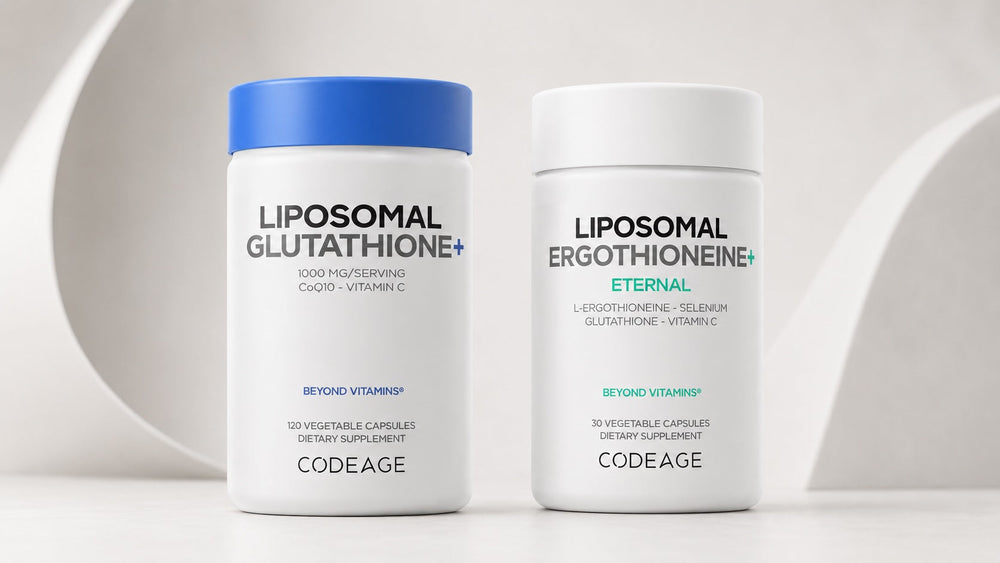
In this regulatory environment, independent certification fills a gap that does not exist in the same form for prescription drugs. The NSF mark, the USP Verified mark, and a handful of other third-party certifications offer something the regulatory framework does not require: pre-market verification of identity, purity, and process. For a buyer trying to decide between two supplement products that look similar on the shelf, the presence or absence of a third-party mark is one of the few publicly visible data points that distinguishes them. The Codeage NSF Certified products — including Multi Collagen Protein Powder and Liposomal Glutathione — carry that mark; the current set is publicly maintained on the NSF registry. The Codeage NSF Certified set continues to grow as additional products are submitted to the programme — each product carrying the mark has been independently audited in its specific formulation. Across the broader catalogue, the same internal disciplines apply: cGMP-compliant manufacturing, formulation rigour, ingredient sourcing standards.
The growing visibility of the NSF mark on supplement labels reflects, in part, a buyer audience that has become more sceptical and more educated. The literature is plain about why: the supplement category is large, the entry barrier is low, and the variation between products can be substantial. A certification mark is one way the visible variation gets a partial answer. This series develops that further in the practical buyer guide at the end of the cluster.
Codeage · NSF Certified · Cross-Pillar Range
A selection of NSF Certified products —
from the Codeage range.
Codeage maintains an NSF Certified range across the four pillars of the Longevity Code. The cards below show three of the products that carry the mark.
Multi Collagen Protein Powder
An NSF Certified product in the Codeage range. Multi-source collagen protein powder — five collagen types in a single formula. Sits within Pillar 02 of the Longevity Code.
View Product →Liposomal Glutathione
An NSF Certified product in the Codeage range. Reduced L-glutathione in a phospholipid vesicle format — the Helix Liposomal delivery system used in select Codeage formulations.
View Product →Liposomal Magnesium Glycinate
An NSF Certified product in the Codeage range. Liposomal magnesium glycinate, a chelated magnesium format in the Helix Liposomal vesicle architecture. Pillar 01 daily-foundation formulation.
View Product →Previously · Pillar 03 · Glutathione cluster
From 1888 to Now — The Long History of Glutathione Research
Codeage · The Longevity Code
A daily system —
built for the cellular long view.
The Longevity Code organises the body's daily chemistry into four pillars. The NSF Certified products sit across the architecture.
Explore The Longevity Code →


