







 Start a live chat
 1-800-870-4800
From 1888 to now —
the long history
of glutathione research.
Joseph de Rey-Pailhade, Montpellier, 1888. Frederick Gowland Hopkins, Cambridge, 1921. Vincent du Vigneaud, Cornell, 1935. Helmut Sies, Düsseldorf, 1985. The history of glutathione research spans more than a century — and runs through some of the most decorated figures in twentieth-century biochemistry.
I
1888 — Rey-Pailhade discovers the substance —
and calls it philothion.
The first published observation of glutathione comes from 1888, from a French chemist named Joseph de Rey-Pailhade, working at the University of Montpellier. Rey-Pailhade was investigating a curious property he had observed in yeast extract: when elemental sulphur was added to the extract, the sulphur disappeared. The yeast appeared to contain a substance that reduced sulphur — that, in chemical terms, donated electrons to it. Rey-Pailhade named the substance philothion — from the Greek for 'love of sulphur.' He could not isolate it. He could not fully characterise it. But he could describe the phenomenon, and he could name it, and that name appears in his 1888 paper.
Rey-Pailhade's discovery sat largely unnoticed for the better part of three decades. The substance he had observed was real, but the chemistry of the era was not yet ready to characterise it. The tools for peptide isolation, the chromatographic methods, the analytical chemistry — all of these would have to be developed before the philothion of 1888 could become the glutathione of the twentieth century. The discovery, in some ways, was ahead of the field. Rey-Pailhade had described a substance the field would not be able to fully understand for another fifty years.
The substance Rey-Pailhade named has been continuously studied ever since. From the 1888 observation to the present day, the published literature on the molecule has grown to many thousands of papers. Few small molecules in cellular biology can claim a continuous research record this long. The introduction article in this cluster places the molecule in its modern context — what has remained, after the long history, is a single tripeptide built from three amino acids and producing some of the most well-mapped cellular chemistry in modern biology.
Rey-Pailhade in Montpellier, 1888.
Hopkins in Cambridge, 1921.
Du Vigneaud in the United States, 1935.
Different cities. Different decades.
The same small molecule.
The timeline of discovery
Five moments in the long arc —
from yeast extract to cellular redox biology.
The cards below mark five moments the literature returns to when it traces the history of glutathione research — from the first observation in 1888 to the integrated cellular redox framework of the late twentieth century.
I
1888 · Rey-Pailhade
Philothion · Montpellier
Joseph de Rey-Pailhade, working at the University of Montpellier, observes that yeast extract contains a substance that reduces elemental sulphur. He names it philothion — Greek for 'love of sulphur.' The discovery is published; the substance cannot yet be isolated.
II
1921 · Hopkins
Glutathione · Cambridge
Sir Frederick Gowland Hopkins, working at Cambridge, isolates a substance from animal tissues with the same sulphur-reducing properties Rey-Pailhade had described. He names it glutathione — the name the molecule has carried ever since. Hopkins receives the 1929 Nobel Prize for separate work on vitamins.
III
1935 · Du Vigneaud
Structure confirmed · United States
Vincent du Vigneaud completes the structural characterisation of glutathione as a tripeptide containing glutamate, cysteine, and glycine — with the unusual gamma-bond between the first two amino acids. Du Vigneaud receives the Nobel Prize in Chemistry in 1955 for separate work on peptide synthesis.
IV
1957 · Mills · GPx
The cycle described
Gordon Mills publishes the description of glutathione peroxidase, the enzyme that converts GSH to GSSG. The conceptual framework of the glutathione redox cycle — connecting the two forms via GPx and glutathione reductase — takes shape across the following decades.
V
1985 · Sies
Redox framework · Düsseldorf
Helmut Sies, working at the University of Düsseldorf, formulates the broader conceptual framework of cellular oxidant-and-antioxidant balance — integrating decades of accumulated observation on glutathione biology into a coherent cellular framework that the field continues to work within.
II
1921 — Hopkins isolates and renames the substance —
glutathione enters the modern literature.
The substance Rey-Pailhade had named philothion was re-encountered, isolated, and renamed in 1921 by the British biochemist Sir Frederick Gowland Hopkins, working at Cambridge. Hopkins was at the height of a remarkably productive career; he would be awarded a share of the 1929 Nobel Prize in Physiology or Medicine (jointly with Christiaan Eijkman) for his work on the discovery of vitamins. In 1921 Hopkins isolated a substance from animal tissues that displayed the same sulphur-reducing properties Rey-Pailhade had described, and he gave it the name by which it has been known ever since: glutathione.
Hopkins's initial characterisation of the molecule, published in 1921 and refined in subsequent papers, described it as a dipeptide containing cysteine and glutamic acid. This characterisation was eventually corrected — the molecule, as Hopkins himself would later acknowledge, is a tripeptide containing also glycine — but the initial isolation and naming were the foundational moment of the modern literature. Glutathione, as a named and isolable substance, entered the working vocabulary of biochemistry through Hopkins's Cambridge laboratory in 1921.
The naming itself is worth noting. The word glutathione is a compound of glut- (from glutamic acid) and -thione (from the Greek theion, sulphur). The name records, in its construction, what Hopkins observed — a peptide built from glutamic acid and containing sulphur. The molecule entered the scientific literature carrying its chemistry in its name, as so many biochemical molecules of the early twentieth century did.
Two Nobel laureates contributed
directly to its characterisation.
Few small molecules in cellular biology
can claim a research lineage
quite like this one.
The research record in numbers
Three observations about a uniquely long-running literature —
spanning more than 130 years of continuous study.
1888
The first observation — Joseph de Rey-Pailhade, University of Montpellier, working with yeast extract
The substance was first described in 1888 by Rey-Pailhade, who named it philothion and recorded its ability to reduce elemental sulphur. The 1888 paper sat largely unnoticed for the next three decades — but the date of first observation remains 1888, and the molecule has been continuously studied ever since.
2 Nobel
Two Nobel laureates contributed directly to the molecule's characterisation — Hopkins (1929) and Du Vigneaud (1955)
Sir Frederick Gowland Hopkins received the 1929 Nobel Prize in Physiology or Medicine (for separate work on vitamins). Vincent du Vigneaud received the 1955 Nobel Prize in Chemistry (for separate work on peptide synthesis, including oxytocin). Both contributed directly to the characterisation of glutathione during their respective careers.
130+ yrs
The continuous research record — from 1888 to the present, one of the longest in modern cellular biology
The molecule has been continuously studied for more than 130 years. Few small molecules in cellular biology can claim a continuous research record this long. The published literature on glutathione runs into many thousands of papers, accumulated across more than a century of research across many disciplines.
III
1935 to now —
Du Vigneaud, the redox cycle, and the modern era.
The full structural characterisation of glutathione as a tripeptide containing glutamate, cysteine, and glycine was completed in 1935 by Vincent du Vigneaud, working in the United States. Du Vigneaud — who would receive the Nobel Prize in Chemistry in 1955 for separate work on the synthesis of biologically active polypeptides, including oxytocin and vasopressin — established the molecular structure of glutathione definitively. The unusual gamma-bond between glutamate and cysteine was also characterised during this period. By the late 1930s the molecule's chemistry was, in its broad outlines, established.
The decades following established the cycle. The recognition that glutathione exists in two forms — reduced GSH and oxidised GSSG — and that the two are interconverted by the enzymes glutathione peroxidase and glutathione reductase, was developed across the mid-twentieth century. The selenium-dependent nature of glutathione peroxidase was established in the 1970s. The full integration of glutathione biology with the broader concept of cellular redox biology came in 1985, when the German biochemist Helmut Sies, working at the University of Düsseldorf, formulated the conceptual framework of cellular oxidant-and-antioxidant balance that integrated decades of accumulated observation into a coherent picture. The cycle article in this cluster describes this dynamic in detail.
The contemporary research on glutathione has continued to expand the picture — examining the tissue distribution, the subcellular compartments, the regulation of synthesis, the genetics of the GCL and GSS enzymes, and the cellular biology across many specific tissues. The Codeage Liposomal Glutathione and the broader Codeage glutathione catalogue are the contemporary expression of a research record that begins in Rey-Pailhade's Montpellier laboratory in 1888 and continues, through more than a century of published work, into the present day. The molecule is part of Pillar 03 of the Longevity Code. Studies referenced were conducted independently and did not involve any specific Codeage product. The literature on glutathione continues to develop; the picture described reflects the current understanding rather than a closed account.
Codeage · Cellular Longevity · Pillar 03
The Codeage glutathione line —
formats from the Pillar 03 architecture.
Formulations from the Codeage glutathione line — the tripeptide the body produces, in formats designed for daily use.
Liposomal Glutathione
The flagship of the Codeage glutathione architecture. Reduced L-glutathione (GSH) supplied in a phospholipid vesicle format — the Helix Liposomal delivery system used in select Codeage formulations. The Pillar 03 anchor of the cellular redox conversation.
View Product →Liposomal Glutathione+
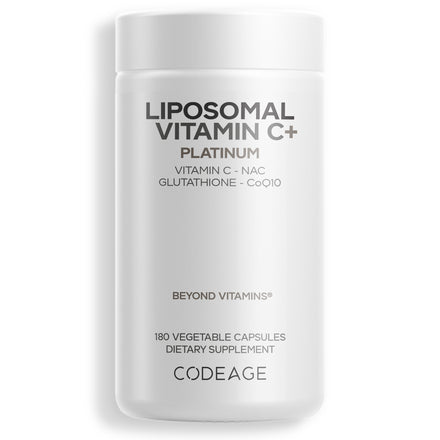
A combination liposomal format pairing reduced L-glutathione with vitamin C and CoQ10 — three molecules the literature has explored in the context of cellular redox biology, brought together in the Helix Liposomal vesicle architecture.
View Product →Amen Glutathione-SR+
A sustained-release glutathione preparation from the Amen line — reduced L-glutathione with a galactomannan matrix designed for extended-release behaviour. Part of the broader Codeage family of glutathione formats.
View Product →Article A7 · Previously in this cluster
Glutathione and Its Precursors — NAC, Glycine, and the Amino Acid Pool
Codeage · The Longevity Code
A century of research —
built into a daily system.
The Longevity Code organises the body's cellular chemistry into four pillars. Glutathione sits within Pillar 03 — the cellular dimension of the architecture.
Explore The Longevity Code →


