






 Start a live chat
 1-800-870-4800
The contaminant categories in supplement testing —
heavy metals, microbial assays,
and what each term covers.
The contaminant categories tested in dietary supplements are well-characterised in the analytical-chemistry literature. Reading what each category covers — what is tested, where the contaminants originate, what general thresholds programmes such as NSF and USP work within — is the foundation of understanding the contaminant question in a measured, informed way.
I
The contaminant categories the literature describes —
what they are, where they come from.
The contaminants of concern in dietary supplements fall into a handful of well-characterised categories. Heavy metals — primarily lead, arsenic, cadmium, and mercury — are the category that has received the most public attention. These metals occur naturally in soil and water and can accumulate in plants and animals over time; supplements that draw on plant-based, marine-based, or soil-adjacent raw materials can carry trace quantities. The contaminant question for heavy metals is not whether any quantity is present — trace amounts are essentially unavoidable in any food or supplement — but whether the quantity exceeds defined thresholds the testing programmes apply.
Microbial contamination is the second major category. The literature distinguishes several sub-categories: total aerobic plate count (a general measure of microbial load), yeasts and moulds, coliforms, salmonella, E. coli, staphylococcus, and a handful of others. The relevant tests are well-established microbiology — the same kinds of assays used in food and pharmaceutical testing. The contaminant thresholds for microbial categories are documented in the cGMP regulations and in the standards of the major certification programmes. The Codeage commitment in the formulation note is that CFU count is measured at time of manufacture and may naturally vary over time, which is the standard industry framing for any product containing live cultures.
Pesticide and herbicide residues are the third major category. Botanical ingredients — herbs, plant extracts, fruit and vegetable powders — can carry residues of the agricultural chemicals used during cultivation. The relevant tests are gas chromatography and mass spectrometry assays that detect specific residue molecules at parts-per-billion sensitivity. The contaminant thresholds vary by ingredient class and by certification programme. The cluster's comparison article places the NSF and USP thresholds side by side. A fourth category — solvent residues from extraction processes used to concentrate some botanical ingredients — also appears in the standards, with its own defined thresholds.
Heavy metals. Microbial. Residues.
Three contaminant categories.
Each with defined thresholds —
each with established tests.
THE CONTAMINANT CATEGORIES
Four contaminant categories described in the analytical literature —
in plain language.
The cards below describe four of the major contaminant categories addressed in the analytical-chemistry literature. Each card identifies what the category includes and what testing methods exist for it. Programmes such as NSF/ANSI 173 and USP incorporate this testing within their audit cycles; the mark on a certified product is itself the public-facing acknowledgment that the testing has been performed against the programme's thresholds.
I
Heavy Metals
Lead, arsenic, cadmium, mercury.
Tested by inductively coupled plasma mass spectrometry (ICP-MS) at parts-per-billion sensitivity. NSF/ANSI 173 and USP both define thresholds — typically based on a daily exposure limit aligned with California Proposition 65 and ICH Q3D guidelines. Trace amounts are unavoidable; the threshold is what matters.
II
Microbial Load
Total aerobic count, yeasts, moulds, pathogens.
Tested by standard microbiology assays — culture plating, qualitative PCR for specific pathogens. The cGMP regulations and certification standards define limits for total counts and absence requirements for pathogenic species (salmonella, E. coli, staphylococcus aureus).
III
Pesticide Residues
Botanical ingredient residues.
Tested by gas chromatography and liquid chromatography mass spectrometry methods that detect specific residue molecules. The certification standards apply ingredient-specific thresholds, often aligned with EU and EPA tolerance levels for the parent food crop.
IV
Solvent Residues
Residues from extraction processes.
Tested by gas chromatography headspace methods. Solvents used in botanical extraction (ethanol, hexane, others) can leave residues; the standards define thresholds for each solvent class. The category matters most for products containing concentrated botanical extracts.
II
What the threshold system actually says —
absolute zero is not the standard.
A point of frequent confusion in the contaminant conversation is the difference between detection and threshold exceedance. Modern analytical instruments — particularly inductively coupled plasma mass spectrometry for heavy metals — can detect trace amounts of contaminants at concentrations far below what would have been measurable a generation ago. A test result that says lead detected at 5 parts per billion is, in modern analytical terms, an essentially routine finding for many plant-sourced ingredients. The relevant question is not whether any lead was detected; the relevant question is whether the detected amount exceeds the defined threshold.
The threshold system the major certifications apply is based on daily exposure limits. For lead, the typical framework is California Proposition 65 — which sets a daily intake limit of 0.5 micrograms — combined with the International Council for Harmonisation (ICH) Q3D guideline for elemental impurities. A product is calculated against the daily serving size: if the lead content per serving, multiplied by daily servings, stays below the limit, the product meets the threshold. The same daily-exposure framework applies to arsenic, cadmium, mercury, and the other monitored metals, each with its own daily limit. Absolute zero is not the standard — and is, given modern detection limits, not analytically attainable for most plant-derived ingredients.
Reading the threshold system clearly avoids two opposite errors. The first is assuming that any detection of a heavy metal in a supplement means a safety problem; the second is dismissing the issue because trace amounts are common. The substantive question — at what level does the contaminant become consequential — has been worked out, with published rationale, by the various standards-setting bodies. The thresholds are public; the testing methods are public; the audited certified products are listed in public registries. The cluster's article on certificates of analysis walks through how to read the actual results.
Detection is routine.
Threshold exceedance is what matters.
The standards have done the work —
of defining where the line sits.
THE TESTING IN NUMBERS
Three observations about contaminant testing —
from the public standards.
ppb
Parts-per-billion sensitivity is the routine standard for heavy-metal testing in modern supplement laboratories.
Modern analytical instruments — particularly ICP-MS — can detect heavy metals at parts-per-billion concentrations. The detection sensitivity is far below what would have been measurable decades ago; what matters in the current testing environment is the threshold, not whether anything was detected at all.
ICH Q3D
The international guideline that defines daily exposure limits for elemental impurities in pharmaceuticals and supplements.
ICH Q3D is the harmonised international standard for heavy-metal exposure limits. The major certification programmes — NSF, USP — align their thresholds with the ICH framework and with California Proposition 65 in the U.S. context.
Lot-by-lot
The major certifications test contaminants on each production lot, not just at certification.
Lot-by-lot testing addresses the variability that can occur between production runs — different ingredient batches, different harvest seasons, different supply-chain sources. Ongoing surveillance is what gives the certification its credibility over time.
III
The Codeage position on contaminant testing —
where the NSF mark applies.
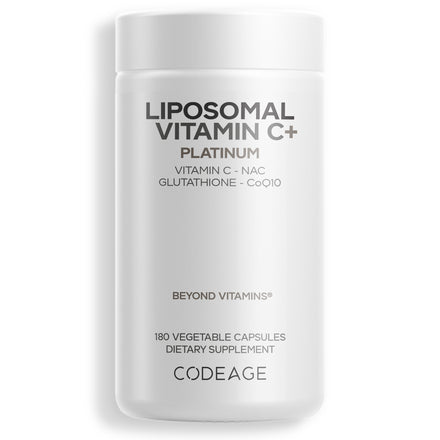
Codeage NSF Certified products — listed on the NSF public registry — carry the NSF/ANSI 173 contaminant testing as part of the certification process — heavy-metal panels, microbial assays, pesticide screens where applicable, ongoing surveillance through the NSF audit cycle. The range includes Multi Collagen Protein Powder, Liposomal Glutathione, Liposomal NMN Platinum, Liposomal Vitamin C+, and others.
The Codeage NSF Certified set continues to grow as additional products are submitted to the programme — foundational daily-use formulations, products with broad athletic relevance, formulations across ingredient categories where the independent audit on contaminant testing adds an externally verified layer to the work. Across the broader catalogue, the same internal manufacturing disciplines apply — cGMP-compliant facilities with contaminant testing protocols appropriate to each ingredient class. The external NSF mark identifies which products currently carry that additional, independently audited layer.
Reading the contaminant question well — knowing the categories, knowing the thresholds, knowing what the testing detects — is part of becoming a more careful supplement buyer in any category. The certification programmes have done the underlying work of defining where the thresholds sit; the testing has been refined over decades; the audited products are publicly listed. The cluster's practical guide brings the contaminant question together with the broader label-reading framework.
Codeage · NSF Certified · Cross-Pillar Range
A selection of NSF Certified products —
from the Codeage range.
Codeage maintains an NSF Certified range across the four pillars of the Longevity Code. The cards below show three of the products that carry the mark.
Multi Collagen Protein Powder
An NSF Certified product in the Codeage range. Multi-source collagen protein powder — five collagen types in a single formula. Sits within Pillar 02 of the Longevity Code.
View Product →Liposomal Glutathione
An NSF Certified product in the Codeage range. Reduced L-glutathione in a phospholipid vesicle format — the Helix Liposomal delivery system used in select Codeage formulations.
View Product →Liposomal Magnesium Glycinate
An NSF Certified product in the Codeage range. Liposomal magnesium glycinate, a chelated magnesium format in the Helix Liposomal vesicle architecture. Pillar 01 daily-foundation formulation.
View Product →Previously in this cluster
Why Independent Certification Exists in the Supplement Category — A Brief Background
Codeage · The Longevity Code
A daily system —
built for the cellular long view.
The Longevity Code organises the body's daily chemistry into four pillars. The NSF Certified products sit across the architecture.
Explore The Longevity Code →


