




 Start a live chat
 1-800-870-4800
CoQ10 and glutathione —
where two molecules meet
in mitochondrial biology.
Most of the molecules in this series share the watery interior of the cell. Coenzyme Q10 does not — it lives in the fatty membranes, and above all in the membranes of the mitochondria. Yet the mitochondrion is also home to a pool of glutathione, which means the two molecules, so different in chemistry, keep the same address.
I
Two molecules that keep the same address —
and could hardly be more different.
Coenzyme Q10 is, in several ways, the opposite of the molecule at the centre of this series. Glutathione is water-soluble, small for a peptide, and made fresh by the cell in large quantities. Coenzyme Q10 — CoQ10 for short, also called ubiquinone — is fat-soluble, built around a long oily tail, and embedded in membranes rather than dissolved in the watery interior. Where glutathione moves freely through the cytosol, CoQ10 stays put in the lipid sheets of the cell, and most of all in the membranes of one particular organelle: the mitochondrion.
The mitochondrion is where the two molecules meet. It is best known as the site where the cell processes energy from food, a job carried out along the folded inner membrane — and CoQ10 is a working part of that membrane machinery. But the mitochondrion also holds its own dedicated pool of glutathione, kept separate from the larger supply in the cytosol, as the article on glutathione's subcellular compartments describes. So within this single organelle, the fat-soluble CoQ10 of the membrane and the water-soluble glutathione of the matrix occupy the same small space, each in its own territory.
This shared address is the reason to read them together. CoQ10 is not a building block of glutathione, nor a member of the watery redox network this series traced through vitamin C. It belongs to the fatty side of the cell. But the mitochondrion is the one place where the watery and fatty redox worlds press right up against each other, and CoQ10 and glutathione are the prominent members of each, sharing the most metabolically active compartment in the cell.
Glutathione works in the water.
CoQ10 works in the fat.
The mitochondrion is the one room
where the two worlds meet.
The four parts of the picture
Four elements of the meeting —
the molecule, its two forms, its day job, and the shared compartment.
CoQ10's relationship to glutathione runs through the mitochondrion. The cards below sketch the four parts the literature returns to most often.
I
Coenzyme Q10
Ubiquinone · the fat-soluble molecule
A fat-soluble compound built around a long lipid tail that anchors it in membranes. The body synthesises most of its own supply, with smaller amounts from the diet. Its name, ubiquinone, reflects how widely it occurs across the membranes of living cells.
II
Ubiquinol
The reduced form · the redox couple
Like the other redox molecules of this series, CoQ10 cycles between an oxidised form (ubiquinone) and a reduced form (ubiquinol). The cycling between the two is central to its role in the membrane, and places it within the cell's wider redox chemistry.
III
The electron chain
The day job · carrying electrons
CoQ10's best-established role is as a mobile carrier in the mitochondrial electron transport chain, ferrying electrons between the large protein complexes embedded in the inner membrane. It is a working component of the cell's energy-processing machinery.
IV
Mitochondrial glutathione
The meeting point · a separate pool
The mitochondrion holds a dedicated pool of glutathione, kept apart from the larger cytosolic supply. It is in this organelle — CoQ10 in the membrane, glutathione in the matrix — that the two molecules share their address.
II
The electron carrier —
a working part of the mitochondrial membrane.
CoQ10's primary role in the cell is mechanical, in the way that much of mitochondrial biology is mechanical. The inner membrane of the mitochondrion holds a series of large protein complexes, arranged in a line, and the cell passes electrons along that line as part of the chain of reactions by which it draws energy from food. CoQ10 is one of the carriers that move electrons from one complex to the next — small enough and oily enough to slip through the membrane, picking up electrons at one station and delivering them to another. It is, in this role, a shuttle rather than a destination.
That shuttling is possible because of the same two-form chemistry this series has seen throughout. When CoQ10 picks up electrons it becomes ubiquinol, its reduced form; when it hands them off it returns to ubiquinone, the oxidised form. The molecule cycles between the two states continuously as it works, the same redox principle that governs glutathione's own GSH and GSSG cycle, only carried out in the fatty membrane rather than the watery interior. In its reduced ubiquinol form, CoQ10 is also described in the literature as the fat-soluble member of the cell's broader redox network — the membrane counterpart to the water-soluble members.
This dual character — a mechanical carrier in the electron chain and a redox molecule of the membrane — is what makes CoQ10 a fitting companion to glutathione in any account of mitochondrial biology, much as the both-soluble alpha-lipoic acid earned its place in the series. The two molecules do different work in different parts of the same organelle, but they share the redox language, and they share the address.
CoQ10 carries electrons through the membrane.
Glutathione cycles them in the matrix.
Same chemistry, same organelle —
two sides of one redox world.
The molecule in numbers
Three observations on CoQ10 and glutathione —
the address, the forms, and the divide they bridge.
One organelle
The mitochondrion, where CoQ10 sits in the membrane and glutathione keeps a dedicated pool
CoQ10 is concentrated in the inner mitochondrial membrane; the mitochondrion also maintains its own pool of glutathione, separate from the cytosol. The two molecules share the cell's most metabolically active compartment, each in its own territory.
Two forms
Ubiquinone and ubiquinol — the oxidised and reduced members of CoQ10's redox couple
CoQ10 cycles between ubiquinone and ubiquinol as it works, the same two-form redox principle that governs glutathione's GSH and GSSG. The shared language of electrons is what links the fatty and watery sides of the redox world.
Two worlds
Fat-soluble CoQ10 and water-soluble glutathione, meeting at the membrane–matrix divide
CoQ10 belongs to the fatty membranes, glutathione to the watery interior. The mitochondrion is the one place where the two redox worlds press directly against each other, with a prominent molecule on each side of the line.
III
Where the two molecules meet —
the mitochondrion as a shared compartment.
The mitochondrion is the right place to close this part of the cluster, because it is where the divisions this series has drawn — watery and fatty, made and eaten, single sulphur and double — all come together in one compartment. CoQ10 sits in the inner membrane, doing its mechanical work along the electron chain. Glutathione keeps a pool in the matrix, the watery space the membrane encloses. The two never merge into one chemistry; they remain a fat-soluble molecule and a water-soluble one, each on its own side of the membrane line. But they are studied together precisely because they are neighbours in the cell's busiest room, members of a redox economy that spans both sides of that line.
The wider literature regards the cell's redox molecules as one interconnected system rather than a set of unrelated parts, and the mitochondrion is where that interconnection is easiest to see. Water-soluble and fat-soluble members, endogenous and dietary ones, single molecules and whole enzyme systems — all linked through the shared currency of electrons, all concentrated in the organelle that handles the most chemistry. CoQ10 and glutathione are among the most studied members on their respective sides, and the relationship between them is an active and developing area of mitochondrial research.
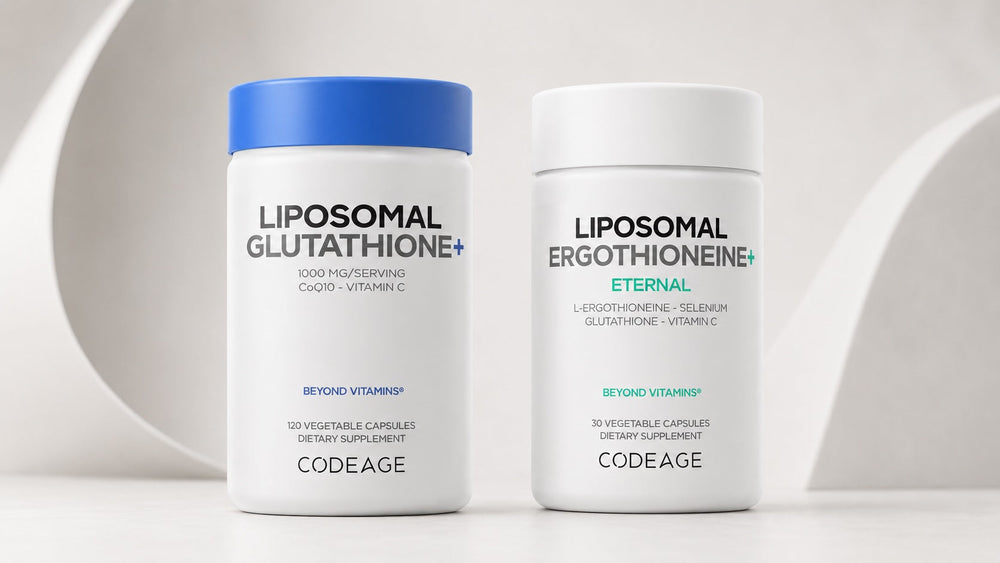
Within the Codeage catalogue, this meeting point is reflected directly. The Liposomal Glutathione+ formulation brings reduced L-glutathione together with CoQ10 and vitamin C in a single liposomal format — the water-soluble tripeptide and the fat-soluble coenzyme in one preparation. Alongside the Liposomal Glutathione formulation, it sits within the Pillar 03 architecture of the Longevity Code, where the molecules of cellular chemistry are housed as one coherent daily system. The literature on CoQ10, glutathione, and mitochondrial biology continues to develop; the picture described here reflects the current understanding rather than a closed account.
Codeage · Cellular Longevity · Pillar 03
The two molecules, together —
formats from the Pillar 03 line.
Glutathione and the coenzyme it shares the mitochondrion with — formulations from the Codeage glutathione line, in formats designed for daily use.
Liposomal Glutathione+
A combination liposomal format pairing reduced L-glutathione with CoQ10 and vitamin C — the water-soluble tripeptide and the fat-soluble coenzyme brought together in the Helix Liposomal vesicle architecture. The direct meeting of the two molecules of this article.
View Product →Liposomal Glutathione
The cornerstone of the Codeage glutathione line. Reduced L-glutathione (GSH) supplied in a phospholipid vesicle format — the Helix Liposomal format used in select Codeage formulations. The Pillar 03 anchor of the cellular redox conversation.
View Product →Liposomal Vitamin C+ Platinum
A liposomal vitamin C formulation built with L-glutathione, NAC, resveratrol, and rutin — molecules the literature has examined in connection with cellular redox biology, assembled in a single Helix Liposomal preparation.
View Product →Previously in this series
Sulforaphane — The Compound Broccoli Makes When Broken
Codeage · The Longevity Code
The molecules of the cell —
within one daily system.
The cellular pillar of the Longevity Code houses the tripeptide and the molecules it shares the cell with as parts of one coherent daily architecture.
Explore The Longevity Code →This article is provided for educational and informational purposes only and has been reviewed against FDA and FTC guidelines to ensure it does not make any health, disease, or treatment claim. Any research or studies referenced were conducted independently and did not involve Codeage products; no Codeage product has been used in any study or to establish, prove, or imply any benefit. These statements have not been evaluated by the Food and Drug Administration. Codeage products are not intended to diagnose, treat, cure, or prevent any disease.


